
Sudan remains the site of the world’s largest displacement crisis, with roughly 14 million people forced from their homes since fighting began in April 2023. The United Nations has now issued a “red alert” over the city of El Obeid, warning that a new wave of mass atrocities could unfold within days. Humanitarian agencies say funding shortfalls and continued foreign arms flows are prolonging the suffering of millions of Sudanese civilians.
Background
Sudan’s civil war erupted on 15 April 2023 between the Sudanese Armed Forces (SAF) and its former ally, the Rapid Support Forces (RSF). The two sides had jointly seized power in a 2021 coup, but a power struggle over integrating the RSF into the regular army spiraled into open combat in the capital, Khartoum.
The fighting quickly spread across the country, tearing through Darfur, Kordofan, and other regions. What began as a domestic power struggle has since evolved into what analysts describe as a regional proxy war, drawing in outside governments and mercenary networks.
Today the country is roughly split in two. The SAF holds much of the east, including Khartoum, which the army recaptured in 2025. The RSF continues to control large parts of Darfur and is pressing an offensive in the central Kordofan region.
Details: How Bad Has the Sudan Displacement Crisis Become
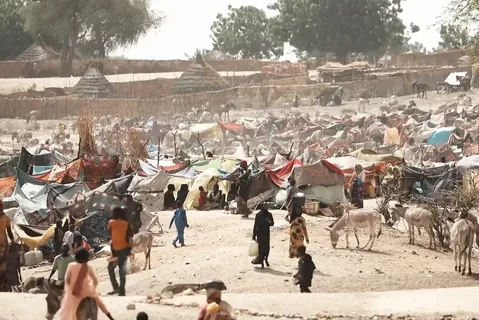
According to United Nations figures, close to 14 million people have been displaced since the war began, including about 9 million people uprooted inside Sudan and more than 4 million who have fled across borders into neighboring countries. The International Organization for Migration has separately reported that more than 15 million people have been forced from their homes since the conflict began, including over 11.5 million displaced within Sudan and roughly 4 million who fled across borders at the crisis’s peak.
The scale of suffering extends well beyond displacement figures alone. Nearly 34 million people, about two-thirds of Sudan’s population, now need humanitarian assistance of some kind. Disease outbreaks including cholera, measles, and dengue have spread through overcrowded camps with little access to clean water or functioning hospitals.
Women and children bear a disproportionate share of the crisis. UN Women estimates that 12.7 million people, mainly women and girls, now require support related to sexual and gender-based violence, a sharp rise from 3.1 million people in 2023. More than half of all internally displaced people in Sudan are under the age of 18.
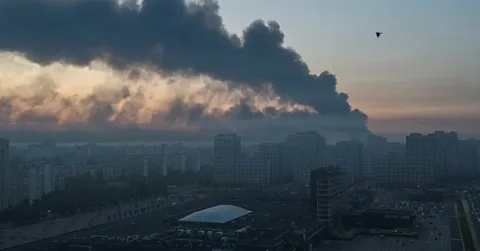
The latest flashpoint is El Obeid, capital of North Kordofan state. The city of roughly half a million residents, which also hosts nearly 100,000 people already displaced by the wider war, has endured siege-like conditions for eighteen months. In recent weeks, RSF drone strikes have knocked out the main power station and fuel depots, cutting off water pumps and plunging entire neighborhoods into darkness.
Between 6 and 28 June alone, at least 45 people were killed and 41 injured in fifteen separate drone attacks on El Obeid and its surrounding areas, according to the UN human rights office. Aid officials warn that a full RSF ground assault could trigger casualties on the scale of the massacre in El Fasher, Darfur, in October 2025, when more than 6,000 civilians were reportedly killed within three days of the city’s fall.
Where Are Sudan’s Refugees Going
Sudanese refugees have scattered across nearly every neighboring state. Chad has absorbed hundreds of thousands of arrivals, with women and children making up the vast majority of those crossing at border points such as Adré. Egypt, South Sudan, Libya, and Ethiopia have also received large refugee populations, often straining already fragile local economies and services.
Inside Sudan, displacement has become increasingly urban. More than half of displaced people are now living in cities rather than rural camps, adding pressure to overstretched hospitals, schools, and water systems in host communities.
There is also a fragile counter-trend. IOM data shows that over three million people have returned to their areas of origin since the war began, with more than a million returning to Khartoum alone after the army recaptured the capital. However, officials caution that most returnees are arriving to destroyed homes, damaged infrastructure, and little in the way of basic services.
Who Is Winning the War in Sudan
Neither side has achieved a decisive victory. The SAF regained control of Khartoum in 2025, a symbolic and strategic win for the army. But the RSF answered by consolidating its grip on Darfur, capturing El Fasher in October 2025, and has since pushed its offensive eastward into Kordofan, threatening to shift momentum back in its favor.
Analysts describe the conflict as a grinding war of attrition, with control of the country roughly split between the RSF-held west and the SAF-controlled east. Neither force appears able to deliver a knockout blow, prolonging the war and, with it, the humanitarian catastrophe.
Who Is Funding the War in Sudan
Sudan’s war has drawn in a wide network of foreign backers, transforming a domestic power struggle into an international proxy conflict. According to research from the Center for Strategic and International Studies, the United Arab Emirates is the RSF’s primary backer, supplying the paramilitary group with weapons and financing routed largely through Chad, Libya, and more recently Ethiopia — a claim the UAE denies.
On the other side, Egypt has provided the SAF with political backing along with logistical and technical support, while Turkey and Saudi Arabia have also sided with the Sudanese military. Reporting has additionally linked Russia’s Wagner Group to gold-mining concessions and military assistance flowing toward RSF-aligned networks, while Moscow has separately pursued naval basing access with the SAF.
US officials, including members of Congress, have acknowledged intelligence findings pointing to the UAE’s role in arming the RSF, though Washington has so far stopped short of imposing direct consequences on Abu Dhabi. Competition for Sudan’s gold reserves and other resources has further entrenched outside interests in prolonging, rather than resolving, the conflict.
Quotes From Officials
UN High Commissioner for Human Rights Volker Türk delivered a stark warning to the UN Human Rights Council on the situation unfolding in El Obeid. He described the signals coming from the city as unmistakable evidence that a new catastrophe was forming, and called on world leaders to treat the moment as an urgent priority rather than another distant crisis.
UN Emergency Relief Coordinator Tom Fletcher struck a similarly grim tone earlier this year, saying the international community had once again failed to meet the moment in Sudan as the war passed its third anniversary. IOM Director General Amy Pope has separately noted that displaced families are showing remarkable resilience, but stressed that returning home does not automatically mean returning to safety or stability.
Regional analysts have also weighed in on the strategic stakes. Researchers tracking the conflict describe the fight for cities like El Obeid as being driven fundamentally by control over power, land, and economic resources rather than ideology alone.
Impact: Regional and Global Consequences
The Sudan crisis has destabilized an already fragile region. Neighboring Chad, South Sudan, and Egypt are absorbing large refugee inflows while managing their own economic and security challenges. Cross-border arms and mercenary flows have further entangled Libya, Chad, and the Central African Republic in Sudan’s conflict dynamics.
Globally, Sudan has become the starkest example of a chronically underfunded emergency. Humanitarian appeals for the country have rarely exceeded 38 percent of needed funding since 2023, and in 2026 only a small fraction of required resources had been secured. This funding gap has compounded food insecurity, with more than 21 million people facing acute hunger.
The crisis has also raised serious accountability questions. UN investigators have documented what they describe as hallmarks of genocide in Darfur, and international bodies including the International Criminal Court have opened assessments into atrocities committed during the fall of El Fasher. Continued foreign arms transfers, despite an existing UN arms embargo on Darfur, have drawn criticism from human rights organizations demanding stronger international enforcement.
Conclusion: What Comes Next
With El Obeid now under what UN officials call a “red alert,” the coming weeks are seen as a critical test of whether the international community can prevent another mass-casualty event similar to El Fasher. Diplomatic efforts, including talks led by the so-called Quad of the United States, Egypt, Saudi Arabia, and the UAE, have so far failed to produce a lasting ceasefire.
Humanitarian officials continue to call for protected corridors, sustained funding, and enforcement of the existing arms embargo as immediate priorities. Absent a genuine political breakthrough, aid agencies warn that Sudan’s displacement crisis, already the largest in the world, is likely to deepen further before it begins to ease.
Frequently Asked Questions
What is the largest displacement crisis in the world?
Sudan currently holds the designation of the world’s largest displacement crisis. Since the civil war began in April 2023, close to 14 million people have been forced from their homes, including roughly 9 to 11 million displaced inside the country and several million more who have fled across international borders into places like Chad, Egypt, and South Sudan. UN agencies have repeatedly confirmed that no other ongoing conflict has produced displacement figures on this scale in recent years, surpassing crises in Ukraine, Syria, and the Democratic Republic of Congo in raw numbers of people uprooted.
What caused the Sudan crisis?
The crisis stems from a power struggle between two former allies, the Sudanese Armed Forces and the Rapid Support Forces, both of which took part in a 2021 military coup. Tensions over a planned integration of RSF fighters into the regular army eventually broke down into open warfare in Khartoum on 15 April 2023. The conflict has since been fueled and prolonged by outside powers supplying weapons, funding, and mercenaries to both sides, turning a domestic dispute into a wider regional proxy war fought partly over Sudan’s gold and land resources.
What are the causes of humanitarian crisis?
Humanitarian crises like Sudan’s are typically driven by a combination of armed conflict, displacement, and the collapse of essential services such as health care, clean water, and food supply chains. In Sudan’s case, direct attacks on hospitals, power stations, and water infrastructure have compounded the effects of mass displacement, triggering disease outbreaks and severe food insecurity. Chronic underfunding of humanitarian appeals, restricted aid access due to ongoing fighting, and the continued flow of foreign weapons into the conflict have all deepened the scale and duration of the crisis, making recovery increasingly difficult for millions of civilians.