
Indonesia breaking news today centers on a ferry disaster off Madura Island, where at least five people have died and 41 remain missing after the passenger vessel Mutiara Sentosa 2 caught fire on Sunday. Rescue teams are racing to reach the burning ship as hundreds of passengers await evacuation.
Background
Indonesia is an archipelago of more than 17,000 islands, and ferries remain one of the most common ways people travel between them. Weak safety enforcement, overcrowded vessels, and passenger counts that often exceed official manifests have made ferry accidents a recurring feature of Indonesia latest news over the years.
This is far from an isolated case. In July 2025, a ferry fire off North Sulawesi killed three people while more than 560 were rescued. Just weeks earlier that same month, a ferry sank near Bali, killing several passengers and leaving dozens missing. This pattern has repeated with troubling regularity over the past year.
The Mutiara Sentosa 2 departed Surabaya in East Java early Sunday morning, bound for Makassar in South Sulawesi province, a routine inter-island route used by hundreds of travelers each week.
Details
According to Indonesia’s National Search and Rescue Agency, known as Basarnas, the ferry was carrying 271 people, 232 passengers and 39 crew members, when the fire broke out between 6 and 7 a.m. local time in waters off Sumenep regency, near the Sapudi Islands north of Madura.
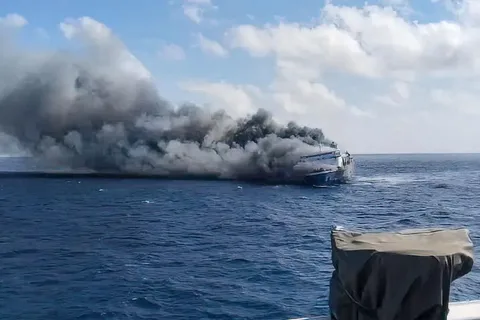
Dramatic footage released by Basarnas showed thick black smoke billowing from the vessel as passengers wearing life jackets gathered on the deck, awaiting rescue. The ferry was reported to be nearly engulfed in flames, with people crowding onto the bridge and bow to escape the smoke below.
A tugboat and a passing vessel reached the scene first and began evacuating passengers shortly before 10 a.m. By Sunday afternoon, nearby ships had rescued 225 passengers and crew members and recovered five bodies, leaving 41 people still unaccounted for. A dedicated rescue vessel was dispatched from Surabaya, though officials estimated it would take roughly six hours to reach the burning ferry.
The cause of the fire remains unknown and is under investigation. This kind of breaking news Jakarta today and across Indonesia’s shipping lanes tends to draw swift scrutiny of vessel safety standards, particularly since passenger manifests in Indonesia frequently understate the true number of people on board.
Quotes
Basarnas said in its official statement that search and rescue operations were continuing, with multiple vessels working to reach survivors still in the water or aboard the burning ferry.
An unnamed rescue official cited in international coverage said the ship caught fire north of the Sapudi Islands, describing a large-scale operation involving several nearby vessels working alongside the coast guard to transfer passengers and cargo to safety.
Indonesian authorities have historically pointed to overcrowding and inconsistent safety inspections as recurring factors in ferry disasters, a pattern echoed again in early statements following Sunday’s fire, though officials cautioned that the specific cause of this blaze had not yet been determined.
Impact
The disaster adds to growing scrutiny of maritime safety standards across Indonesia’s inter-island ferry network, which serves as a critical transport link for an economy spread across thousands of islands. Each new incident renews pressure on regulators to enforce passenger limits and improve firefighting equipment aboard aging vessels.
For families in East Java and South Sulawesi, the wait for information about missing loved ones is likely to stretch on for days, mirroring the anguish seen in earlier disasters like the 2025 Bali ferry sinking, where dozens remained missing for an extended search period.
Internationally, the incident is likely to draw renewed attention to Indonesia’s maritime safety record. This issue tends to resurface each time a major vessel accident occurs, often prompting brief diplomatic concern from countries with citizens who regularly travel the region.
Conclusion
With search and rescue operations still underway and dozens of passengers unaccounted for, the death toll from Sunday’s ferry fire could rise in the coming days. Indonesian authorities are expected to launch a formal investigation into the cause of the blaze once the rescue operation concludes, adding another chapter to the country’s long history of ferry safety failures.
For readers tracking Indonesia latest news live, Basarnas is expected to issue regular updates as the search continues and survivors are processed at nearby ports. This story is likely to stay near the top of Indonesia breaking news today in English coverage until the full scale of the tragedy is confirmed.
Frequently Asked Questions
What is the current condition of Indonesia?
Indonesia remains Southeast Asia’s largest economy, but it continues to face a mix of economic pressure, political tension, and recurring natural and transport-related disasters. Over the past year, the country has seen periods of significant civil unrest tied to public frustration over government spending and lawmakers’ perks, alongside ongoing challenges like maritime safety failures, such as Sunday’s ferry fire, and its status as one of the most seismically active nations on earth due to its position along the Pacific Ring of Fire. Economically, Indonesia continues to grow, but a large share of its workforce remains in the informal sector, and rising living costs have fueled public frustration in recent years.
Why are Indonesians protesting?
Large-scale protests swept across dozens of Indonesian cities in 2025 and into 2026, driven primarily by public anger over generous financial perks awarded to members of parliament at a time when many ordinary Indonesians were struggling with rising costs and job losses. The unrest was further fueled by frustration over government corruption, police violence during earlier demonstrations, and broader concerns about military involvement in civilian affairs following changes to Indonesia’s armed forces law. President Prabowo Subianto’s government responded with a mix of concessions, including rolling back some lawmaker benefits, and security crackdowns that saw thousands of protesters detained.
What conflict is happening in Indonesia?
Beyond the political unrest in major cities, Indonesia has also seen an escalation of conflict in its Papua provinces, where separatist insurgent groups have continued fighting against Indonesian security forces for greater autonomy or independence. The government has responded by deploying additional troops to the region. Separately, religious minorities in parts of Java and Sumatra have faced attacks from extremist groups, according to human rights organizations tracking conditions across the country. These distinct conflicts, political unrest in urban centers and the long-running Papua insurgency, represent two very different but ongoing sources of instability within Indonesia today.