
The White House officially announced the launch of Gaza ceasefire phase 2 on 14 January 2026. US Special Envoy Steve Witkoff announced it as a move from “ceasefire to demilitarization, technocratic governance, and reconstruction.”
According to Palestinian sources who spoke to Anadolu Agency, the roadmap for phase two includes the following elements:
A complete cessation of military operations must be confirmed before phase two can fully progress. A National Committee for the Administration of Gaza would be established to oversee public institutions, services, and a comprehensive financial and administrative review of the territory. An international stabilization force would be deployed to monitor the ceasefire, secure aid delivery, and support the new governance structure. A gradual Israeli military withdrawal from Gaza would follow an agreed timetable, though the specific details of that withdrawal remain under negotiation.
The Council on Foreign Relations confirmed that Gaza ceasefire phase 2 was formally triggered after Israel confirmed in January 2026 that Hamas had returned the remains of the final Israeli hostage, Ran Gvili fulfilling the key condition for moving to the next stage.
However, the transition has not been smooth. Israel expressed opposition to launching phase two while Hamas disarmament remained incomplete. Hamas, for its part, said it would not implement any part of the deal unless Israel fulfilled its own obligations, specifically the commitment to withdraw from Gaza. That standoff has kept both sides in a tense holding pattern.
Did Israel Break the Ceasefire in Gaza?
This is perhaps the most pressing question surrounding the Gaza ceasefire 2026: did Israel break the ceasefire in Gaza? The answer, based on documented evidence, is that ceasefire violations have occurred on a significant and repeated scale.
According to Gaza’s Government Media Office, Israel violated the ceasefire agreement at least 3,795 times between October 10, 2025 and July 19, 2026. These violations included air strikes, artillery bombardments, direct shootings, residential area raids, and the demolition of civilian properties.
Since the truce took effect, Israeli attacks have killed at least 1,214 Palestinians and injured nearly 4,000 others, according to Al Jazeera’s tracking of Gaza health authority figures. This includes strikes on hospitals, police stations, and civilian vehicles.
One of the deadliest episodes occurred on 29 October 2025, when Israel killed 109 people including 52 children following an exchange of gunfire in Rafah that killed one Israeli soldier. US President Donald Trump publicly backed the Israeli response, calling it “retribution.”
Israel has also continued to restrict humanitarian aid from reaching parts of Gaza. On 1 January 2026, Israel suspended permits for more than three dozen aid organizations. Gaza health officials and the United Nations have both stated that aid levels during the ceasefire period remained far below the minimum quantities required under the agreement.
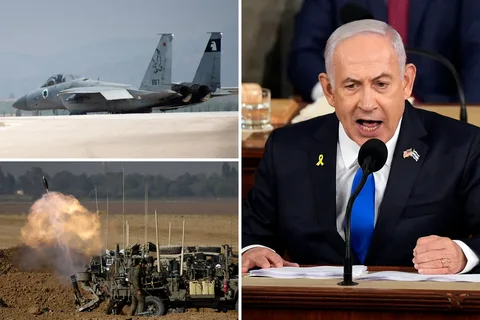
Israel has additionally continued to expand the so-called “Yellow Line” a buffer zone inside Gaza further into the territory. Critics and legal experts have argued that this expansion violates the terms of the ceasefire framework. Israeli Prime Minister Benjamin Netanyahu later announced plans to take military control of 70 percent of Gaza’s territory, far exceeding the terms of the October 2025 agreement.
Israel’s position has been that it is targeting Hamas fighters who remain active inside Gaza, and that it is responding to violations by Palestinian armed groups. The Israeli military maintains that any strikes it carries out are against legitimate military targets.
Israel’s Response to the 20-Point Gaza Peace Plan
Israel’s relationship with the 20-point Gaza peace plan has been complicated. While Prime Minister Netanyahu initially said he accepted the framework, Israel conveyed formal comments and concerns to the United States and stated that the version made public did not fully reflect its position.
Israel’s core objections centered on two issues: the disarmament of Hamas and the question of hostage remains. Netanyahu made clear on multiple occasions that he would not agree to begin full phase two negotiations until Hamas had returned all hostage remains and committed concretely to disarmament.
Hamas, meanwhile, indicated in talks held in Cairo that it was willing in principle to transfer its weapons to a mutually agreed Palestinian body but rejected handing them directly to Israel. Hamas spokesperson Basem Naim stated that the issue in Gaza was “fundamentally political, not security-based,” and that the occupation itself not Hamas weapons was the core problem.
By May 2026, Nikolay Mladenov, the high representative for Gaza to the Board of Peace, confirmed that the phased peace plan was “paralyzed” over the Hamas disarmament question.
Global Reaction and Impact
The Israel Gaza ceasefire agreement has drawn wide international attention and intervention. France welcomed the launch of phase two and called for it to pave the way for Hamas disarmament and the eventual return of a reformed Palestinian Authority to Gaza. The French government expressed gratitude to the US, Egypt, Qatar, and Turkey for their mediation roles.
A joint statement by the foreign ministers of Qatar, Jordan, UAE, Indonesia, Pakistan, Turkey, Saudi Arabia, and Egypt welcomed Trump’s efforts to end the war in Gaza. The Board of Peace a group of 27 countries signed onto the peace framework held its first formal meeting in Washington on 18 February 2026 to deliberate on Gaza’s future.
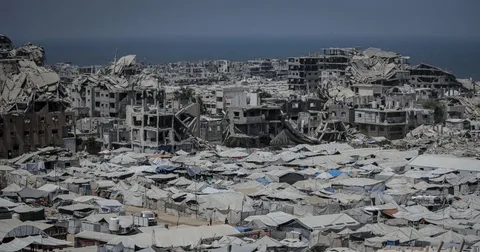
The United Nations announced that by January 2026, 100 percent of basic food needs in Gaza had been met for the first time since 2023 a significant humanitarian milestone. However, aid organizations on the ground noted that the primary challenge by that point had shifted to shelter, with most of Gaza’s population rendered homeless by the destruction of residential infrastructure.
The International Court of Justice continues to review a case accusing Israel of genocide in Gaza. Human rights organizations have also documented potential war crimes by both sides during the conflict.
What Happens Next
The path forward for the Israel Gaza ceasefire agreement and Trump’s 20-point Gaza peace plan depends on resolving several deeply difficult issues. Hamas disarmament, Israeli troop withdrawal, the composition and funding of the governance committee, and the deployment of an international stabilization force all remain unresolved.
The situation on the ground is still volatile. Israeli strikes have continued on a near-daily basis during the ceasefire period, even as diplomats in Cairo, Doha, and Washington work to move the peace process forward. The humanitarian situation, while improved compared to the height of the conflict, remains severe for the 2.2 million Palestinians living in Gaza.
Whether the Gaza ceasefire 2026 holds and whether Trump’s 20-point peace plan leads to a lasting resolution will depend on political decisions being made in Jerusalem, Gaza, Washington, and across the region in the weeks and months ahead.
FAQs
Who denied the ceasefire in Gaza?
The history of ceasefire denials in Gaza involves both sides at different points in the conflict. Israeli Prime Minister Benjamin Netanyahu was widely reported to have delayed or rejected multiple ceasefire proposals at different stages of the war. In October 2023, Netanyahu flatly rejected calls for a ceasefire, saying such calls were “calls for Israel to surrender to Hamas” and declaring it was “a time for war.” Throughout 2024, Netanyahu rejected several Hamas counterproposals, including one that called for Israeli withdrawal and a long-term truce. On the other side, Hamas was accused by Israel and the United States of blocking progress on phase two of the October 2025 ceasefire by refusing to commit to disarmament. As of mid-2026, the situation remains contested both sides accuse the other of failing to meet their ceasefire obligations.
Does Hamas still exist in Gaza?
Yes, Hamas continues to exist and operate inside Gaza as of 2026, though the organization has been significantly weakened by more than two years of intense Israeli military operations. Hamas’s political bureau continues to function, with representatives participating in ceasefire negotiations in Cairo and other capitals. The military wing of Hamas, the Qassam Brigades, also remains active inside Gaza, which has been a key point of dispute in phase two negotiations, as the United States and Israel have demanded full disarmament as a condition for implementing the next stages of the peace plan. Hamas has indicated it is willing in principle to transfer its weapons to a Palestinian body other than Israel, but it has firmly rejected full disarmament as long as Israeli forces remain in Gaza or the occupation of Palestinian territory continues.
What country has the most Palestinians in the world?
According to data from the Palestinian Central Bureau of Statistics, there are approximately 15.5 million Palestinians worldwide as of the end of 2025. The largest concentration of Palestinians outside of historic Palestine itself is found in Jordan, which hosts an estimated 2.3 million registered Palestinian refugees, according to UNRWA figures, with some broader estimates placing the total Palestinian-origin population in Jordan even higher. Within historic Palestine including the West Bank and Gaza Strip approximately 7.4 million Palestinians reside. In the broader diaspora, Jordan is followed by Israel, where around 2 million Arab citizens of Palestinian origin live. Syria and Lebanon also host large registered refugee populations, though those numbers have been affected by Syria’s own prolonged internal conflict.