
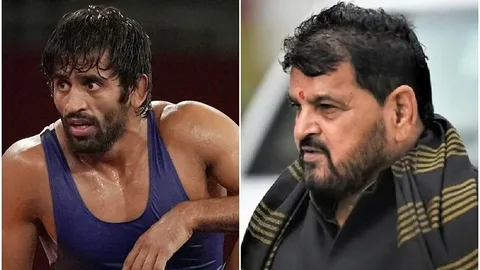
The origins of this case go back to January 2023, when a group of around 30 Indian wrestlers staged a sit-in protest at Jantar Mantar in New Delhi. Among them were Olympic medallists Bajrang Punia, Vinesh Phogat, and Sakshi Malik three of the most decorated wrestlers in Indian history.
The wrestlers publicly accused Brij Bhushan Sharan Singh, who served as WFI President from 2012 to 2023, of sexually harassing female athletes over a prolonged period. A total of seven women filed complaints, including one minor. The protesters demanded Singh’s arrest, the dissolution of the WFI executive committee, and the public release of an oversight committee report.
The protest triggered massive national attention. It was one of the most unusual and courageous moments in Indian sports history elite Olympic athletes, many of them national heroes, putting their careers and reputations on the line to accuse a powerful politician from the ruling party. The wrestlers also threw their medals into the Ganges River as a mark of protest, a deeply symbolic act that moved millions across the country.
The Supreme Court eventually stepped in, with then-Chief Justice DY Chandrachud calling the allegations serious. Delhi Police filed two FIRs in April 2023 after the wrestlers approached the Supreme Court over alleged inaction.
Details of the Case and the Verdict
The FIR named Brij Bhushan Sharan Singh and Vinod Tomar following complaints from six adult women and one minor. One complainant described how female athletes travelled in groups to avoid being alone with Singh. Another complainant alleged Singh had physically touched her inappropriately at an international championship.
The POCSO case involving the minor was separately closed by a Delhi court in May 2025 after the child’s father sought withdrawal and Delhi Police said they found no corroborative evidence. That case never proceeded to trial.
For the adult complainants’ case, sexual harassment charges were framed against Singh in May 2024. The case was heard extensively in camera. Senior Advocate Rebecca John represented the women wrestlers, while Advocate Rajiv Mohan appeared for Singh.
In Monday’s verdict, ACJM Ashwini Panwar found that the prosecution had not established the charges to the standard required under criminal law. A detailed written judgment has yet to be released. Both Singh and Tomar now stand fully acquitted at the trial court level.
Singh’s Reaction: “Today Is a Happy Day”
Brij Bhushan Sharan Singh made his feelings clear in a statement shortly after the acquittal was announced. He told reporters that he had always maintained his innocence from the very beginning.
“On the first day, when my first statement came, I had said that if any verdict or any charge is proven, I will hang myself,” Singh said. “Today, the court acquitted me with honour. Today is a happy day.”
Singh, who served six terms as a Member of Parliament from Kaiserganj in Uttar Pradesh, had been a towering figure in both Uttar Pradesh politics and Indian wrestling administration. Known as a “Bahubali neta” in political circles, he has survived multiple serious controversies over the course of his career, including cases related to the demolition of the Babri Masjid and connections to criminal elements both of which ultimately ended in acquittals.
Bajrang Punia and Vinesh Phogat: “We Have Not Lost Hope”
The reaction from the wrestlers who led the fight was immediate and resolute. Bajrang Punia and Vinesh Phogat posted a joint statement on X within hours of the verdict, making clear they would not accept the acquittal as the final word.
“We are deeply saddened that the court did not find Brij Bhushan Sharan Singh guilty of the allegations of sexual violence levelled by the female wrestlers,” the statement said.
The two wrestlers also hit out at what they called institutional protection of a powerful political figure. “We had to gather a lot of courage to take to the streets and file an FIR against a powerful, strongman politician from the ruling party. Leveraging his political power and muscle, Brij Bhushan intimidated many girls into withdrawing their complaints,” they wrote.
“From the very beginning, the entire system, the government and the establishment have been working to protect Brij Bhushan,” they alleged.
Both Punia and Phogat confirmed that the women wrestlers had instructed their lawyers to appeal against the verdict at the earliest possible opportunity in a higher court. “The female wrestlers have instructed their lawyers to appeal against this verdict, and this will be done as soon as possible. We have not lost hope, and the wrestlers will continue their fight,” Phogat wrote.
Wrestling Sexism: A Deeper Issue at Stake
The case was never just about one man. It became a lightning rod for the broader issue of wrestling sexism the way women athletes in Indian sport are treated by administrators, officials, and governing bodies that are overwhelmingly male-dominated and politically connected.
The wrestlers’ protest exposed how deeply power is concentrated in sports federations in India, where the line between political influence and sports administration is often blurred. Brij Bhushan Sharan Singh was not just a federation chief he was a sitting Member of Parliament with decades of political reach and the kind of connections that give few people reason to challenge him.
The fact that women wrestlers some of them Olympians had to sleep on pavements at Jantar Mantar and throw their medals into a river just to be heard spoke volumes about the environment they were working in. International sports organisations and human rights groups took notice. The United World Wrestling (UWW) expressed concern and temporarily suspended the WFI from international competition.
The acquittal, while a legal outcome, does not erase the questions that the protest raised about how women athletes in India report harassment, whether they are believed, and whether the systems around them are capable of delivering justice.
Brij Bhushan Sharan Singh Net Worth and Political Profile
Brij Bhushan Sharan Singh was born on 8 January 1957 in Gonda, Uttar Pradesh. He served six terms as a Member of Parliament, representing Gonda, Balrampur, and Kaiserganj constituencies across his career. He completed his LLB degree from Dr. Ram Manohar Lohia Avadh University in 1985.
As for Brij Bhushan Sharan Singh’s net worth, his declared assets as reported in election affidavits put his wealth at approximately Rs 9.89 crore. His wealth comes from a combination of his political career, his long tenure heading the Wrestling Federation of India, and other personal assets. He has described himself as coming from a modest background, with his political and public profile built over decades of work in Uttar Pradesh.
He served as WFI President from 2012 until December 2023, when he stepped down amid the legal proceedings. His tenure of over a decade made him one of the most powerful figures in Indian wrestling administration. He was also instrumental in the sport’s infrastructure development during his time at the federation.
Karan Bhushan Singh: The Son Who Took the Seat
When the controversy surrounding Brij Bhushan Sharan Singh reached its peak, the BJP made a strategic decision ahead of the 2024 general elections they dropped him as a candidate and instead fielded his younger son, Karan Bhushan Singh, for the Kaiserganj Lok Sabha seat.
Karan Bhushan Singh, born on 13 December 1990, is a lawyer and national-level double-trap shooter. He holds a BBA and law degree from Dr. Ram Manohar Lohia Avadh University and a diploma in business management from Australia. He won the Kaiserganj seat in the 2024 general elections and has been serving as a Member of Parliament since June 4, 2024.
Karan also took over from his father as President of the Uttar Pradesh Wrestling Association in February 2024. Before that, he had served as vice president of the association for eight years. The transition from father to son in both politics and wrestling administration was widely noticed and interpreted as the family’s strategy to maintain its grip on the constituency while distancing from the controversy.
Bajrang Punia’s Separate Troubles
Bajrang Punia, one of the most vocal protesters among the wrestlers, has had his own challenges in the aftermath of the protest. In November 2024, Punia was handed a four-year ban by the National Anti-Doping Agency (NADA) for refusing to provide a urine sample to doping control officers in March 2024.
Punia, who won a bronze medal at the Tokyo 2020 Olympics, denied refusing the test and said he was innocent. The ban effectively ended his competitive career at a time when he had been expected to compete at future international tournaments. The timing of the ban, coming just months after the wrestlers’ protest, drew sharp criticism from supporters who felt the establishment was targeting the athletes who had spoken out.
Despite his suspension, Bajrang Punia remained at the forefront of the response to Monday’s acquittal and co-signed the joint statement with Vinesh Phogat pledging to continue the legal fight in a higher court.
The Global and Regional Impact
The verdict sends a difficult message to women athletes in India and across South Asia. Many sports commentators and women’s rights advocates pointed out on Monday that the acquittal whatever its legal basis reinforces the perception that powerful men in Indian sport can escape accountability.
Internationally, sports governance bodies including UWW and the International Olympic Committee (IOC) had been watching the case closely. The protest had already led to the WFI’s temporary international suspension. The outcome of this trial will likely be reviewed by those organisations as they assess whether Indian wrestling administration has genuinely reformed.
The wrestling sexism debate has also drawn attention to how few women sit on the boards of Indian sports federations. Across multiple national governing bodies, male politicians continue to hold administrative roles while the athletes particularly female athletes have little formal recourse when abuse occurs.
What Comes Next
The legal story is not over. Vinesh Phogat and Bajrang Punia have confirmed that the women wrestlers will appeal the trial court acquittal at a higher court level. The appeal process could take months or even years to conclude.
Separately, the broader question of how India governs its sports federations continues to attract attention. Reforms promised at the height of the 2023 protest including stronger oversight mechanisms, independent complaints procedures, and greater representation for athletes have been only partially implemented.
For the women who filed the original complaints, the fight has already cost them enormously. Years of legal proceedings, public scrutiny, and political pressure have tested their resolve. That they are still prepared to appeal the verdict despite all of this is, in its own way, a form of courage that mirrors the courage they showed in January 2023 when they first walked to Jantar Mantar.
FAQs
What is the Phogat controversy?
The Phogat controversy refers to two separate but interconnected events involving wrestler Vinesh Phogat. The first is her central role in the 2023 Indian wrestlers’ protest against Brij Bhushan Sharan Singh, the former Wrestling Federation of India president, whom she and other athletes publicly accused of sexual harassment and intimidation. Phogat was one of the most prominent faces of the protest, having previously told Prime Minister Narendra Modi about her concerns as far back as 2021. She helped organize the sit-in at Jantar Mantar in New Delhi and spoke openly about the culture of harassment within the WFI. The second event that brought Phogat into global focus was her disqualification from the Paris 2024 Olympics, which added an extraordinary layer of tragedy to an already turbulent period in her career. She had reached the final of the women’s 50kg wrestling category, defeating the defending Olympic champion and becoming the first Indian woman to reach a wrestling final at the Games only to be disqualified on the morning of the gold medal bout for failing to make weight.
Which Indian wrestler got disqualified?
Vinesh Phogat was the Indian wrestler who was disqualified from the Paris 2024 Olympics, in what became one of the most heartbreaking moments in Indian sporting history. Phogat had dominated the women’s 50kg freestyle wrestling competition, defeating four-time world champion and defending Olympic champion Yui Susaki of Japan in her very first match one of the biggest upsets of the entire Paris Olympics. She then defeated Ukraine’s former European champion Oksana Livach in the quarterfinals and Cuba’s Pan American Games champion Yusneylis Guzman in the semifinal, becoming the first Indian woman in history to reach an Olympic wrestling final. However, on the morning of the gold medal bout against American Sarah Hildebrandt, Phogat was found to be approximately 100 grams above the 50kg weight limit at the mandatory weigh-in.
What happened with Vinesh Phogat?
Vinesh Phogat’s story is one of the most remarkable and painful in Indian sports history. She became one of India’s most decorated wrestlers, winning gold at the Commonwealth Games, Asian Games, and Asian Championships, and bronze at two World Championships. She also became one of the most courageous voices in Indian sport when, in January 2023, she led a public protest against Brij Bhushan Sharan Singh, the powerful WFI President and BJP MP accused of sexually harassing female wrestlers. The protest attracted global attention and ultimately led to a criminal case. Vinesh was one of the primary complainants and faced enormous pressure including alleged intimidation throughout the legal process. At the Paris 2024 Olympics, she produced one of the performances of her career, defeating the world number one before reaching the final. But she was disqualified on August 7, 2024, for failing to make the 50kg weight limit by 100 grams just hours before what would have been a historic gold medal match. She announced her retirement from wrestling the same week in a deeply emotional statement.