Pakistan Economic Stability: PM Shehbaz Sharif Tells US Business Delegation the Economy Is Moving Towards Growth

Summary
Prime Minister Shehbaz Sharif told a delegation of US-based Pakistani business leaders on Thursday that Pakistan economic stability has taken hold and the country is now moving towards growth. Speaking on the sidelines of the 81st session of the United Nations General Assembly in New York, he invited the delegation to explore fresh investment opportunities across several key sectors.
Background
Pakistan has spent the last two years working through a stabilisation programme tied to reforms backed by the International Monetary Fund. Inflation, which had climbed as high as 38 percent, has since come down to single digits, and the central bank’s policy rate has been cut to 11 percent. Officials have repeatedly pointed to these numbers as evidence that the economy has turned a corner after a period of severe financial strain.
The prime minister’s meeting in New York came at a moment when the government has been trying to rebuild investor confidence among overseas Pakistanis, particularly in the United States, where a large expatriate business community has long been seen as an underused source of capital and expertise.
Details
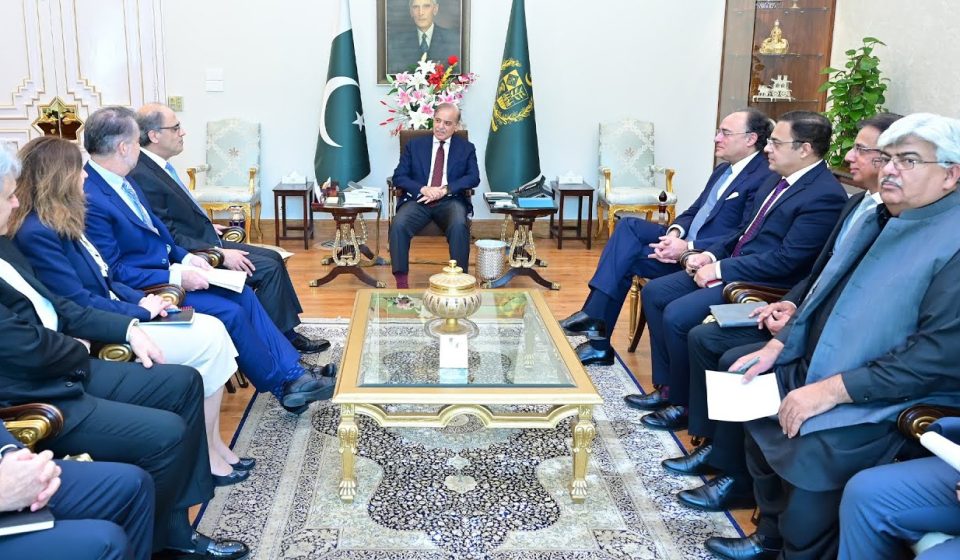
PM Shehbaz met with representatives of the US-Pakistan Business Council and the Business Council for International Understanding during the UN General Assembly session. He told the delegation that Pakistan had carried out substantial structural reforms, including digitisation of the economy, an overhaul of the Federal Board of Revenue, and expanded e-governance systems.
He pointed to agriculture, mining, information technology, energy, ports and shipping, and privatisation as sectors where Pakistan is actively seeking foreign and expatriate investment. The prime minister also described the government’s role as one of facilitation rather than direct participation, saying it should act as a catalyst for the private sector instead of competing with it.
Separately, the premier discussed regional peace efforts in the Middle East during talks with the UN secretary-general, noting that instability in the Gulf had affected Pakistan at an inconvenient time for its recovery.
Quotes
Addressing the business delegation, the prime minister said, “Our economy is now stable. We have moved towards growth.” He added that June had been a particularly strong month for the economy, though conditions became more difficult in the months that followed as regional tensions increased.
Impact
A stronger economic narrative from Islamabad matters beyond Pakistan’s borders. Overseas investors, credit rating agencies and multilateral lenders all watch these signals closely when deciding how much risk they are willing to take on in the country. For the Pakistani diaspora in the US, an improving economic story could translate into renewed interest in remittance-linked investment schemes, joint ventures and direct business partnerships.
Within Pakistan, the emphasis on sectors like IT, energy and ports suggests the government is trying to diversify beyond its traditional reliance on textiles and agriculture. Whether that translates into actual capital inflows will depend on follow-through: business delegations hear pitches like this regularly, and commitments on paper do not always turn into signed deals.
Conclusion
The prime minister’s remarks add to a string of similar statements made over recent months, as the government continues to argue that Pakistan’s economy has stabilised after a difficult stretch. The real test will come in the months ahead, as officials look to convert diplomatic engagement in New York into concrete investment commitments, particularly from the US-based Pakistani business community that PM Shehbaz addressed directly this week.
FAQs
How is the economy in Pakistan now?
Pakistan’s economy is currently described by government officials as stabilised and on a path toward growth. Inflation has fallen sharply from a peak of around 38 percent to single digits, and the State Bank of Pakistan has lowered its policy rate to 11 percent as price pressures have eased. The government has pointed to structural reforms, including digitisation of tax collection and expanded e-governance, as key drivers of this turnaround. Independent assessments, including a United Nations report on global economic prospects, have also noted improvements in Pakistan’s current account position and foreign exchange reserves, though risks tied to external financing and industrial output remain part of the picture.
Is Pakistan GDP 400 billion?
Pakistan’s nominal GDP has moved past the 400 billion dollar mark in recent years. Various estimates for 2025 and 2026 put the figure in a range of roughly 410 to 452 billion dollars, depending on the source and the year being measured. The variation reflects differences in exchange rate assumptions and the timing of national accounts revisions, but the broad picture is consistent: Pakistan’s economy has grown past the 400 billion dollar threshold in nominal terms, while its purchasing power parity GDP is considerably larger, estimated at more than 2 trillion dollars.
What is the rank of Pakistan’s economy?
By nominal GDP, Pakistan currently ranks around 40th among the world’s economies. When measured by purchasing power parity, which adjusts for differences in price levels between countries, Pakistan’s ranking improves significantly to roughly 20th globally, reflecting its large population and domestic consumption base. Pakistan’s GDP per capita, however, remains comparatively low on a global scale, which is why officials continue to emphasise export-led growth and foreign investment as priorities going forward.