
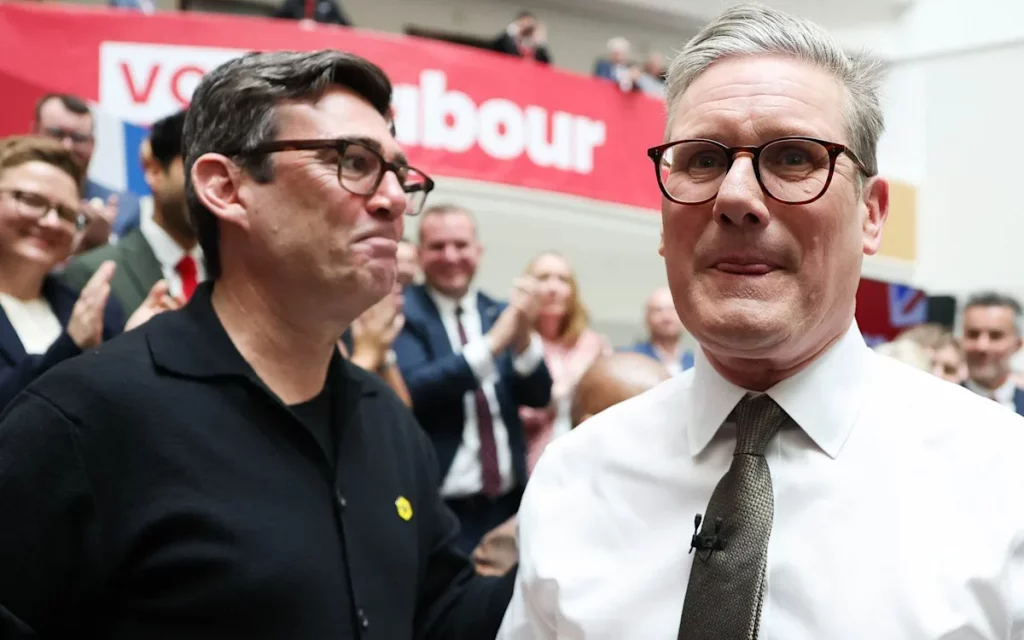
UK politics today is at a turning point rarely seen in modern British history. Prime Minister Keir Starmer is battling to survive a full-scale rebellion inside his own Labour Party. At the same time, Greater Manchester Mayor Andy Burnham has made a bold move announcing his bid to re-enter Parliament fuelling election news today UK-wide about who will lead Labour next.
Background: How Did It Come to This?
Labour swept to power in the 2024 general election with a massive majority. But the honeymoon ended quickly. The government faced sustained criticism from across the political spectrum — figures on the right denounced its approach to immigration and tax increases, while figures on the left condemned its stance on the Gaza War, welfare reform, and its refusal to introduce a wealth tax.
Those controversies stacked up fast. By the end of 2025, opinion polls rated Starmer as one of Britain’s most unpopular prime ministers, drawing comparisons to Liz Truss. This is the backdrop against which the latest UK government news today is unfolding.
The Local Election Disaster That Changed Everything
The breaking point came with the May 2026 local elections. Labour lost nearly 1,500 seats in English councils, while the hard-right Reform UK party won a total of 1,454 seats in England.
Things were even worse in Wales. At the 2026 Senedd election, Welsh Labour suffered a massive defeat which ended 100 years of Labour control of Wales, relegating them to third place behind the governing Plaid Cymru and Official Opposition Reform UK.
The BBC’s projected national vote share made grim reading. It indicated that Labour would receive just 17% of the vote if the local elections had taken place across the whole country in joint third with the Conservatives and down nearly half from the general election.
Starmer Digs In But MPs Are Walking Out
Despite the scale of the collapse, Starmer has refused to go. He told his cabinet he will remain in office despite growing calls for his resignation, saying the process for challenging the leader of the Labour Party had not been triggered.
His message to MPs was blunt. “The country expects us to get on with governing. That is what I am doing and what we must do,” Starmer told a meeting of his cabinet.
But the cabinet itself is split. The Telegraph reported that six of its members were telling Starmer to step down, including Foreign Secretary Yvette Cooper, Home Secretary Shabana Mahmood, Defence Secretary John Healey, Energy Secretary Ed Miliband, and Culture Secretary.
By mid-May, the rebellion had grown significantly. Over 95 Labour MPs had called on Starmer to resign or set out a departure timetable, and one cabinet minister Health Secretary Wes Streeting along with four junior ministers had resigned.
Who Is Andy Burnham And Why Is Everyone Talking About Him?
This is the question dominating UK politics news Starmer coverage right now. Often referred to as the “King of the North,” Burnham has held the mayoral position in Greater Manchester since 2017 and is currently the most popular figure in the Labour Party, according to a YouGov ranking.
His appeal crosses traditional Labour dividing lines. Analysts say Burnham has appeal because of his apparent distance from the “Westminster bubble.” He leans into his outsider status, despite having served as a prominent member of Labour’s front bench both in power and in opposition.
The numbers back his popularity. A poll completed in early May showed 42% of Labour members would pick Burnham as their preferred choice, should a leadership contest take place.
The By-Election Move That Changes the Game
This is the most significant piece of election news today UK watchers have been waiting for. Labour lawmaker Josh Simons stepped down to make it possible for Burnham to run in a by-election in Makerfield, Greater Manchester.
Burnham made his case directly to voters. “I grew up in this area and have lived here for 25 years. I care deeply about it and its people. I know they have been let down by national politics,” Burnham said as he announced his run.
He framed his return as bigger than one constituency. Burnham described his potential return to Westminster as an opportunity to bring “the change we have brought to Greater Manchester to the whole of the UK and make politics work properly for people.”
Markets Worry Pound Wobbles
The latest government news today has not just rattled Westminster. It has hit financial markets too. The British pound slumped and gilts sold off as markets weighed a sharp pivot to the left by a potential new UK prime minister. Investors say UK financial assets and sterling could now face an “elevated political risk premium
European partners are also watching nervously. Analysts warned that the EU may be less interested in negotiating a much closer relationship with the UK if there is uncertainty about who will be prime minister in a few months.
Other Names in the Leadership Race
Burnham is not the only candidate being mentioned in UK politics today discussions. Key names include Wes Streeting, who hails from the right flank of the Labour Party and is seen as a key rival, and former Deputy Prime Minister Angela Rayner.
However, not all contenders are without complications. Rayner’s ability to run is hampered until an investigation into her tax affairs is resolved. She resigned in 2025 after admitting she had underpaid stamp duty on a flat, which she said was the result of improper legal advice.Former Health Secretary Wes Streeting is also viewed as a serious contender, and he recently described Burnham as “one of Labour’s best players.”
Quotes From Key Figures
Junior minister Miatta Fahnbulleh, who resigned, said Starmer had “lost the trust and confidence of the public.” Safeguarding minister Jess Phillips also stepped down, saying she was “not seeing the change I think I and the country expect.”
Meanwhile, leading pollster Professor Sir John Curtice delivered a damning verdict. He accused the prime minister of not having a vision for the country and said he does not believe Starmer can “learn to be a politician,” adding that Burnham represents Labour’s best hope of keeping Nigel Farage out of Downing Street.
Impact: What This Means for the UK and Beyond
UK politics news Reddit and BBC World Politics news forums are full of debate and rightly so. The crisis has wide implications. Reform UK’s surge, now winning more council seats than Labour, signals a rightward shift among traditional working-class voters that no Labour leader can ignore.
Britain’s political landscape has shifted rapidly, particularly with the rise of Reform UK and widening dissatisfaction among working-class voters. Burnham’s ability to connect with multiple Labour factions may give him an advantage over more divisive candidates.
Internationally, a period of leadership instability weakens Britain’s hand in trade negotiations, particularly with the EU and the United States, at a time when both relationships need careful management.
Conclusion: What Happens Next?
The Makerfield by-election is now the most-watched political contest in the UK. If Burnham wins his seat, the path to a leadership challenge becomes far more credible. Starmer has stated he would stand in a leadership challenge, and the contest would require 81 Labour MPs 20% of the party in the House of Commons to formally trigger one.
Whether Labour rallies behind Starmer, pivots to Burnham, or fractures further into competing camps, the outcome will shape British politics for the next decade. One thing is certain: the latest UK government news today is moving faster than at any point since the chaos of 2022.
FAQs
Who won politics in the UK?
Labour won the 2024 general election with a large majority under Keir Starmer. However, by 2026 the party is in deep crisis following massive losses in local elections, with Reform UK and the Green Party making major gains across England and Wales.
What are the biggest social issues in the UK?
The biggest social issues in the UK right now include the cost-of-living crisis, housing affordability, NHS waiting times, immigration policy, welfare reform, and growing inequality between London and the regions. These issues have all contributed to Labour’s falling poll numbers.
Which party is ruling in the UK right now?
Labour is currently the ruling party in the UK, led by Prime Minister Keir Starmer. The party holds a majority in the House of Commons following the 2024 general election, but faces serious internal pressure and the lowest poll ratings of any governing party in recent memory.