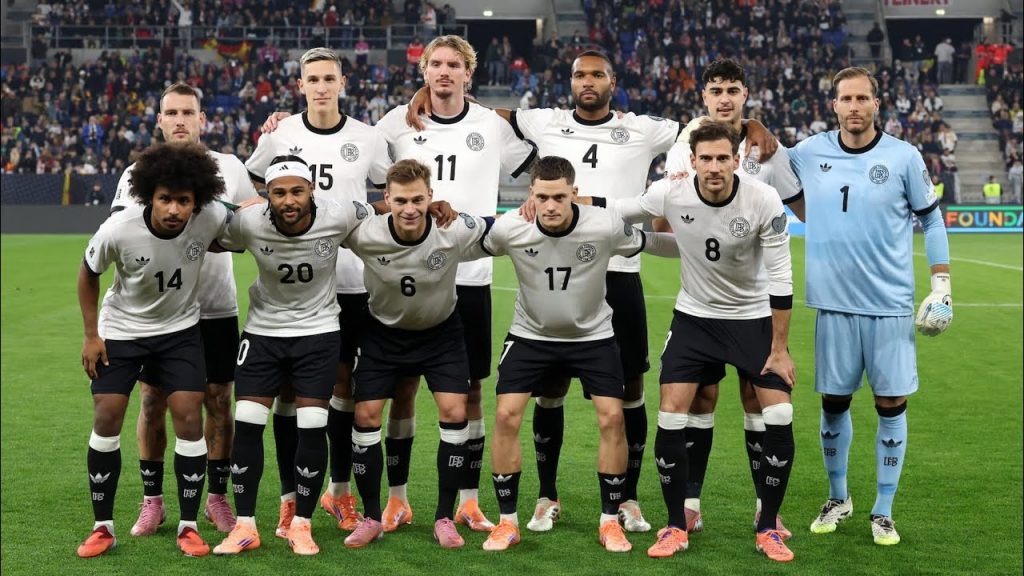
Germany is back in the conversation the way Germany tends to be back in the conversation quietly, methodically, and with enough substance behind the talk to make the rest of the tournament take notice. Discussions around Germany football strong start players have been picking up across fan communities and analyst circles alike, fueled by convincing form in international fixtures and a squad that looks like it has genuinely found its footing again.
Along the way, the conversations keep looping back to two very different reference points the ghost of Germany vs Brazil 7-1, which still gets cited every time someone wants to illustrate what German football looks like at its most ruthlessly efficient, and the upcoming Germany vs Curacao World Cup 2026 fixture, which carries its own tactical interest even if the gap in football histories between the two nations is considerable.
Background: Germany’s Football Legacy
To understand what Germany football strong start players means in 2026, it helps to know where this team has come from and it has come from a complicated few years for a nation that is not accustomed to being questioned.
Germany’s football legacy is built on things that do not go out of fashion quickly: tactical discipline, collective organization, and an ability to perform in tournament environments when the stakes are highest. Four World Cup titles. Multiple European Championship appearances deep into knockout rounds. A production line of world-class talent that has almost never run dry.
But the years between 2018 and 2022 tested that reputation seriously. Early exits and performances that looked uncertain in ways German football rarely had been put pressure on the federation to rethink its approach. The question was not whether Germany would come back — it was how long the rebuild would take and what it would look like when it arrivedThe answer, increasingly, looks like: sooner than expected, and better than feared.
Germany Football Strong Start Players and Current Form
The phrase “Germany football strong start players” captures something real about how this squad is being perceived right now. The rebuild that seemed painful while it was happening has produced a group that blends experience with youth in a way that looks coherent rather than experimental.
The experienced players in the squad provide the structural backbone understanding of positioning, reading of the game, and the ability to stay calm when pressure mounts. The younger players around them bring something different: pace, pressing intensity, creativity in tight spaces, and a willingness to take risks that can unlock defenses that organization alone would keep shut.
Coaches have been deliberate about building around principles rather than personnel. Ball control, quick transitions, structured defensive compactness, and the ability to switch between phases efficiently these are the systems that define how this Germany team plays, and they have been visible in the form that has generated the current conversation.
Germany vs Brazil 7-1: A Match That Changed Football Analysis
No discussion of Germany’s football identity is complete without going back to the semifinal in Belo Horizonte in 2014 — the Germany vs Brazil 7-1 result that is still, more than a decade later, one of the most analyzed ninety minutes in football history.
What made that match so remarkable was not just the scoreline, though a 7-1 defeat for the host nation of a World Cup is extraordinary enough on its own. It was the systematic nature of the destruction. Germany did not score seven goals through individual moments of brilliance scattered across a chaotic game they scored them through collective movement, coordinated pressing, and an ability to exploit Brazil’s defensive disorganization with a ruthlessness that looked almost mechanical.
That efficiency is what analysts keep returning to when they reference the match. It became a case study in how modern football tactics high pressing, fast transitions, coordinated forward movement can dismantle even a technically gifted side when the mental and structural conditions align in favor of one team.
For Germany football strong start players discussions, the 7-1 serves as both a historical benchmark and a reminder of the ceiling this team can reach when everything clicks.
Germany vs Curacao: World Cup 2026 Focus
The Germany vs Curacao World Cup 2026 fixture sits at the opposite end of the emotional register from the Brazil semifinal, but it carries its own kind of significance.
Curacao is a small island nation that has been steadily building its football profile and earning the right to compete on bigger stages. Qualifying for a World Cup represents an enormous achievement for a football program of their size, and they will not approach this match as a formality — they will approach it as an opportunity to show what they are capable of against one of the sport’s most established nations.
Germany, for their part, will be expected to dominate. The question is not really whether they will control the match — it is how they control it, and what the fixture reveals about the tactical options available to the coaching staff ahead of the matches that will ultimately define their tournament.
Germany vs Curacao Match Analysis
When football analysts look at Germany vs Curacao, the tactical conversation centres on a few specific dimensions.
Ball possession is the obvious starting point. Germany’s system is built around controlling the ball and controlling the tempo they will expect to have the majority of possession and to use it constructively rather than just safely.
The high defensive line Germany typically operates is effective against teams that build from the back patiently, but it requires the defensive structure to be well-organized and the offside trap to work efficiently. Curacao’s approach will likely test the defensive line primarily through set pieces and quick transitions rather than sustained possession play.
Wing-based attacking movement has been one of Germany’s most consistent sources of danger in recent fixtures getting wide players into positions where they can cross or cut inside creates problems that compact defenses struggle to solve for ninety minutes.
Midfield control and creative play between the lines is where Germany’s current generation is strongest, and the Germany vs Curacao fixture gives those players room to demonstrate their quality without the immediate pressure they would face against top-tier opposition.
Global interest in Germany vs Curacao highlights, the Germany vs Curacao score, and Germany vs Curacao live coverage reflects a wider audience that is curious about what this Germany squad looks like when given the opportunity to express itself fully.
Germany vs Curacao World Cup 2026 Expectations
The Germany vs Curacao World Cup 2026 matchup is not being treated as a foregone conclusion by the most thoughtful analysts — not because the outcome is genuinely uncertain, but because of what the fixture can tell you about Germany that a comfortable result against a straightforward opponent does not always reveal.
Can Germany manage the scoreline without switching off? Can fringe players make convincing cases for selection in harder matches? Does the tactical structure hold its shape even when the competitive pressure is reduced? These are the questions that make this fixture interesting beyond the ninety minutes themselves.
For Curacao, the match is a genuine opportunity. Playing against Germany at a World Cup is the kind of experience that develops a football program regardless of the scoreline, and the preparation required to even compete in this environment will leave marks on Curacao’s football culture that matter long after the tournament ends.
Tactical Evolution of Germany
The Germany that is showing strong form in 2026 is not the same Germany that won the World Cup in 2014, and it is not the Germany that stumbled in 2018 and 2022. It has evolved in specific and deliberate ways.
The shift has been from a football identity built primarily on physical presence and structural discipline toward something more technically expressive. Current systems emphasize high pressing winning the ball back quickly when it is lost alongside quick passing transitions that move the ball from defense to attack before opposition teams can organize. Flexible attacking formations mean that the system does not depend on any single player occupying a specific role, and younger players have been integrated into senior football in a way that treats them as genuine contributors rather than future investments.
This evolution is not universally complete there are still moments where Germany looks more comfortable in familiar territory than in genuinely chaotic game states. But the direction of change is clear, and the Germany football strong start players discussion reflects recognition that the evolution has reached a point where results are following it.
Expert Opinions
Analysts who watch Germany consistently tend to land on the same observation: the team’s greatest strength is not any individual player but the stability of its system. Even when specific personnel are unavailable or below their best, the collective structure keeps the team functional in ways that squads built around individual brilliance sometimes cannot manage.
The challenge that experts also consistently identify is the step up in quality from comfortable group-stage fixtures to matches against the best teams in the tournament. Germany’s system works — the question is whether it works against sides that have the technical quality and tactical sophistication to exploit whatever vulnerabilities exist within it. Knockout football has its own logic, and Germany’s recent tournament history suggests that the system’s resilience under that specific kind of pressure is still being proven.
Impact on Global Football
Germany’s influence on how football is played extends well beyond what happens to their own national team in any given tournament. The tactical models associated with German football organized pressing systems, positional discipline, structured transitions have been adopted and adapted by coaching staffs around the world at club and international level.
The Germany vs Brazil 7-1 match accelerated something that was already happening: the global recognition that modern football tactics could make individual talent almost irrelevant when the collective system was functioning at a high level. That lesson has been absorbed by coaches on every continent.
Fixtures like Germany vs Curacao World Cup 2026 also serve a function in the broader football ecosystem they give developing national programs experience against elite opponents that simply cannot be replicated in regional qualification matches, and they expose youth players and football administrators in smaller nations to the standards that define the game at its highest level.
Conclusion
Germany enters the World Cup 2026 looking more like themselves than they have in several years tactically coherent, collectively motivated, and with enough quality across the squad to compete in the matches that will actually determine how far they go.
Whether the conversation is about historic reference points like Germany vs Brazil 7-1 or forward-looking analysis of Germany vs Curacao World Cup 2026, the thread running through all of it is a team that has rediscovered what makes German football work and is backing that rediscovery with results.
Germany football strong start players will keep being discussed for as long as that form holds. And if the early signs are anything to go by, that conversation has some time to run.
FAQs
How good is Germany’s football team?
Germany sits at the very top tier of international football by any meaningful historical or contemporary measure. Four World Cup titles, multiple deep runs in European Championships, and a consistent ability to produce players who compete at the highest club level globally all contribute to a football identity that commands genuine respect rather than just reputation. What makes Germany particularly interesting in 2026 is that after a period of underperformance relative to their historical standards, the current squad appears to have rediscovered the combination of system stability and individual quality that has defined their best tournament runs.
Who is Germany’s main striker?
Germany’s attacking structure in the current era does not rely on a single fixed centre-forward in the traditional sense. The coaching staff has leaned toward systems where attacking responsibilities are shared across multiple players a number ten who moves between the lines, wide forwards who cut inside, and midfielders who arrive late into the box. This makes Germany less predictable as an attacking unit and more difficult to defend against, but it also means the question of who is the “main striker” does not have a clean single answer in the way it once might have.
Who are the top three goalkeepers?
Germany has a proud goalkeeping tradition, having produced several of the most respected keepers in football history figures known for their command of the penalty area, shot-stopping reflexes, and ability to organize defenses from the back. The current generation continues that tradition, with multiple keepers at senior clubs demonstrating the quality that has historically kept Germany’s goalkeeping standard among the highest in international football. Specific rankings among the current crop depend on form and selection criteria that shift over any given season.