
Indonesia has sentenced four military officers for the acid attack on rights activist Andrie Yunus a case that has become one of the most serious Indonesia human rights controversies of 2026. The conviction is significant not because attacks on activists are rare in Indonesia, but because the attackers were military personnel and they were actually prosecuted. Human Rights Watch Indonesia and international organizations welcomed the verdict while making clear they consider it a floor, not a ceiling.
Background
Andrie Yunus was a known quantity before the attack. He had been publicly criticizing military-linked operations and raising accountability concerns about security institutions for years. That made him a target. The Indonesia acid attack happened after he pushed publicly on those issues, and the assault serious enough to cause lasting facial injuries was not random.
The case pulled Indonesia human rights conditions into international coverage immediately. Human Rights Watch news coverage, regional legal commentary, and statements from foreign governments all landed within days of the attack becoming public. What distinguished the Andrie Yunus acid attack from other human rights recent cases in the region was the alleged direct involvement of active military officers. That element made it harder to dismiss and harder for Indonesian authorities to quietly let pass.
Indonesia has faced criticism over human rights recent cases for years. Activists, journalists, and minority communities have all documented patterns of harassment and intimidation. What made this case different was the evidence trail and the public pressure that built fast enough to move the legal system.
Details of the Indonesia Acid Attack
The court found all four military officers guilty of planning and executing the attack. Prosecutors presented evidence that the assault was deliberate Yunus was followed before the attack, and the choice of acid as a weapon was intended to cause permanent damage and send a message to others watching.
Witness testimony described the targeting clearly. The acid caused serious facial injuries. Medical experts testified about the recovery timeline multiple surgeries, years of rehabilitation, permanent scarring. This was not meant to be survived without consequences that lasted.
Rights groups described the verdict as a rare moment in a region where prosecution of security personnel for violence against activists almost never reaches this stage. Several organizations noted immediately that the sentences handed down were shorter than they had argued for, and that questions about senior officials with potential connections to the planning remain unanswered.
The Human Rights Watch Indonesia statement following the verdict made both points explicitly: the conviction matters, and it is not enough.
Reaction from Human Rights Groups
Human Rights Watch Indonesia called the convictions an important step and used the same statement to press for the reforms that would make this kind of accountability routine rather than exceptional. The organization specifically raised concerns about military influence on justice processes the fact that this case reached a conviction does not mean the institutional pressure that enabled the attack has been addressed.
Amnesty International and regional legal organizations described the ruling as meaningful for Southeast Asia human rights accountability more broadly. Successful prosecution of military personnel in connection with violence against a civilian activist is uncommon enough that the case has become a reference point in regional discussions.
Legal experts drew attention to the symbolic dimension of acid attacks specifically. They are chosen for a reason the injuries are permanent and public, and the message to others watching is explicit. The Andrie Yunus acid attack fits a pattern documented in articles related to human rights across multiple Asian countries: acid as a deliberate tool of intimidation against people who make themselves visible through their work.
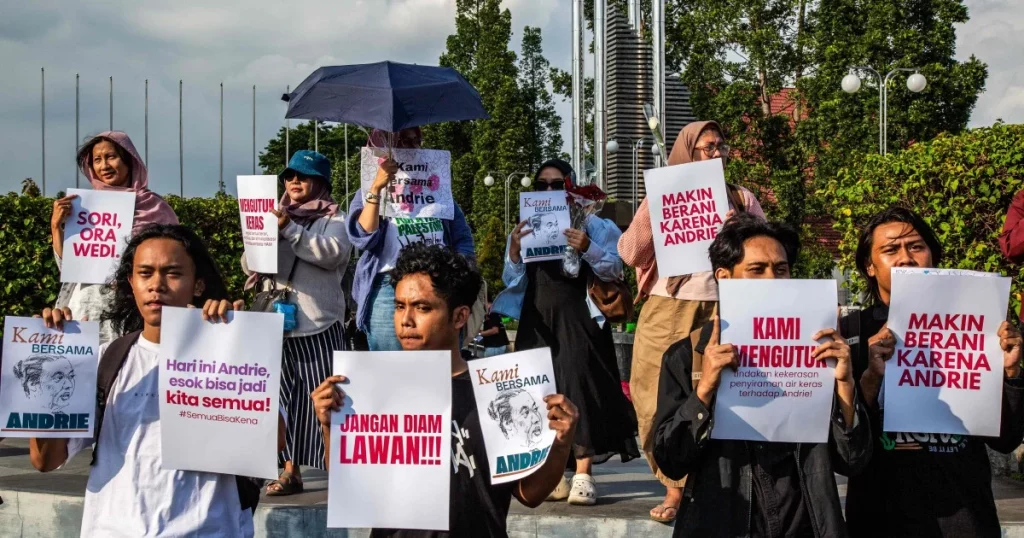
Demonstrations in Jakarta followed the verdict. Students and civil society organizations carried banners demanding fuller accountability and stronger democratic protections. Some protesters argued explicitly that warnings about threats to Yunus had been available before the attack and were not acted on.
Political and Social Impact
The Indonesia acid attack case has created real pressure on the government ahead of policy debates on security reform and civil rights. Opposition lawmakers made the argument that military institutional oversight needs to be stronger the kind of argument that gains traction when the evidence supporting it is this visible.
Indonesia’s international positioning matters here. It is generally viewed as one of Southeast Asia’s more stable democracies, and the country’s relationships with international partners partly rest on that perception. Human rights recent cases that reach global coverage complicate that framing in ways that diplomatic offices notice.
The verdict may also shift behavior among other people facing intimidation who are watching to see whether the system responds. Rights advocates have said openly that they hope the conviction signals to potential attackers that military connection does not guarantee impunity. Whether that signal holds depends on what happens in the next several cases, not just this one.
Social media attention around the Indonesia acid attack remained intense through the verdict. Thousands of posts supporting Yunus, criticizing institutional violence against activists, and sharing Human Rights Watch news coverage kept the case in public view throughout the legal process.
International Response
Indonesia’s role in regional diplomacy and economic partnerships meant the case was followed by foreign human rights offices and diplomatic observers from early on. Several governments urged transparency during the investigation and trial. The UN Special Rapporteurs on the situation of human rights defenders issued statements flagging the broader pattern of attacks on activists across Southeast Asia.
Human rights experts have described the Indonesia acid attack as a potential benchmark case — one that could be cited in future accountability arguments in the region precisely because it went further than most comparable situations do. Articles related to human rights published after the verdict noted how unusual successful prosecution of security personnel remains across Asia.
The handling of the case going forward whether senior official connections are investigated, whether sentences hold on appeal, whether the institutional reforms that rights groups are asking for actually materialize will determine how significant the benchmark actually becomes.
Media Coverage and Public Discussion
The Andrie Yunus acid attack sustained public attention at a level that is not typical for Indonesia human rights cases. The combination of military involvement, the severity of the injuries, and the victim’s public profile kept the story running through the full length of the investigation and trial.
Human Rights Watch Indonesia published regular updates throughout. Journalists covering the case noted that the military element drove unusual public interest a news article about human rights involving security forces carries different weight than one involving unidentified civilians.
Digital activism contributed to the sustained attention. Hashtags around the case spread across Southeast Asia and connected to broader conversations about activist protection and military accountability in the region.
Conclusion
Four military officers convicted for the Indonesia acid attack on Andrie Yunus is a verdict that matters. It is also a verdict that rights organizations are treating carefully not as resolution but as evidence that accountability is possible when pressure is sustained and documentation is solid.
The deeper questions the case raised about Indonesia human rights conditions, military institutional culture, and protections for activists have not been answered by the convictions. Human Rights Watch Indonesia, Amnesty International, and regional organizations are pushing those questions forward. What happens to them in policy, in subsequent cases, in institutional behavior will determine how much the verdict ultimately means.
FAQs
What happened in Indonesia recently?
The most prominent Indonesia human rights story of 2026 is the conviction of four military officers in connection with the acid attack on activist Andrie Yunus. Yunus had been publicly critical of military-linked operations and accountability issues before the attack. The assault caused serious injuries and triggered immediate reactions from Human Rights Watch Indonesia, international rights organizations, and foreign governments. The case became significant because military personnel were actually prosecuted something that is uncommon in the region — and because it raised broader questions about activist safety and institutional accountability in Indonesia.
How rich is Dr. Yunus?
Dr. Muhammad Yunus, the Nobel Prize-winning Bangladeshi economist known for microfinance work, is a completely separate person from Andrie Yunus, the Indonesian rights activist in this case. They share a surname but nothing else. Dr. Muhammad Yunus’s personal wealth has never been the focus of his public profile his work has been oriented toward poverty reduction and social enterprise rather than personal accumulation. Exact figures on his personal finances are not publicly documented in any reliable way.
Is social media blocked in Indonesia?
Major social media platforms operate normally in Indonesia under ordinary circumstances. The government has historically used temporary internet and platform restrictions during periods of significant unrest or protest throttling access or blocking specific apps for limited periods. Outside those episodes, online discussion in Indonesia is active and largely unrestricted. The Andrie Yunus acid attack case was extensively discussed on Indonesian social media throughout the investigation and trial, which contributed to keeping public and international attention on the proceedings.