
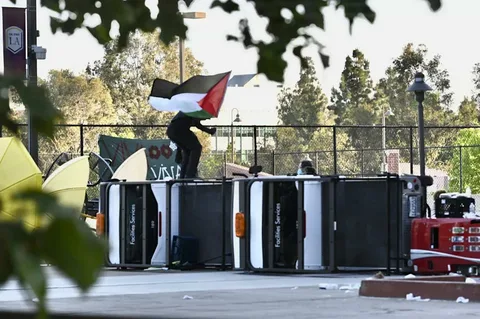
For two years, critics dismissed the pro Palestine campus protests as noise that would fade once graduation season ended. That’s no longer such an easy argument to make. Several former student organizers just won major primary races in New York City, and their victories are being read as proof that the college campus protests today did more than fill headlines they built a political movement with staying power.
Background
It started in the fall of 2023, not long after the Israel-Hamas war broke out. Tents began going up on university lawns, first at a handful of schools, then at more than a hundred campuses across the country, Columbia and UCLA among the most visible.
The demands were fairly consistent from campus to campus: schools should disclose their financial ties to Israel and to weapons manufacturers, and cut those ties where they existed. Students disciplined, arrested, or expelled during the protests wanted amnesty. Columbia became something of a flashpoint for the whole movement, absorbing repeated security crackdowns, a string of congressional hearings, and academic sanctions against student leaders.
Plenty of commentators were skeptical this would ever translate into real political power. National polling at the time showed Gaza wasn’t a top-tier issue for most young voters, and several pro-Israel voices predicted the encampments would burn out without leaving much of a mark on future elections.
Details
That prediction hasn’t held up well. In a set of closely watched Democratic primaries in New York City, multiple candidates who cut their teeth organizing pro-Palestine campus protests won convincingly. The clearest example is Darializa Avila Chevalier, a former Columbia organizer who unseated a long-serving congressman for the party’s nomination.
Just a year ago, almost nobody outside her own circles knew her name. She ran with the backing of New York City Mayor Zohran Mamdani, whose own path to City Hall had already suggested that outspoken criticism of Israel’s conduct in the war wasn’t the political liability many assumed even in a city with one of the largest Jewish populations in the country.
Two other candidates Mamdani endorsed won their congressional primaries that same night. Down the ballot, several more critics of Israeli government policy picked up wins in state and city races, including a candidate now positioned to become New York’s first Palestinian state senator.
People who’ve spent the last two years tracking these protests say none of this happened overnight. Researchers monitoring pro-Palestinian demonstration activity have logged thousands of separate protest days at hundreds of American schools since October 2023 the vast majority of them peaceful, even though media coverage tended to focus on the handful of clashes that turned violent.
Quotes
Beth Miller, political director at Jewish Voice for Peace Action, called the New York results a turning point for how Democratic politicians will likely handle this issue going forward. In her view, the results show that clearly backing Palestinian rights has become a route to winning elections rather than a career risk.
Heba Gowayed, a sociology professor at the City University of New York, told reporters the outcome reflects a real shift in what’s now considered acceptable in mainstream politics. She argued that establishment thinking which for years treated criticism of Israel as a nonstarter took a genuine hit at the ballot box.
Impact
New York wasn’t an isolated event, according to political analysts watching the race. The same mix of young voters, campus alumni, and grassroots organizers behind these wins is already active in other states with contested Democratic primaries coming up, which puts pressure on national party strategists to rethink how future candidates talk about Israel and Gaza.
There’s polling data behind that pressure, too. Advocacy groups point to surveys showing a strong majority of likely Democratic primary voters now want party leadership to take a harder line on arms transfers to Israel — a considerable shift from two years ago, when most elected Democrats avoided the subject almost entirely.
Universities are dealing with a stranger version of this shift. Many schools tightened their rules around encampments, protest hours, and demonstration approvals after the disruption of spring 2024. Now some of those same administrations are watching former student organizers step directly into elected office not an outcome many of them planned for.
Beyond the US, the story is being watched as a signal of where Western public opinion on the Gaza war might be heading, especially among younger voters who came of age during the conflict. Israeli media and regional commentators have described the past few weeks as among the roughest stretches in years for pro-Israel political organizing in America.
Conclusion
Whatever else it was, this movement has clearly outgrown the encampments that first put it on the map back in 2024. What began as students camping out on campus lawns has now produced a new class of elected officials running on those same demands. Nobody can say for certain whether that momentum carries through the next national election cycle, but organizers aren’t waiting for a verdict they’re pointing to New York as the proof they’ve been asking for all along.
FAQs
Why is Gen Z protesting?
A lot of it comes down to exposure. Many in this generation grew up watching the Israel-Hamas war unfold on their phones in real time, which gave them a much more direct, constant window into what was happening in Gaza than previous generations had during earlier conflicts. Surveys consistently find that younger voters hold more critical views of Israeli government policy than older Americans do, and many say they feel a personal obligation to speak up about civilian casualties and human rights concerns.
Are girls allowed to go to school in Palestine?
Yes. Girls across Palestinian territories, including the West Bank and Gaza, have a legal right to attend school, and education has long been highly valued in Palestinian society literacy rates among Palestinian women are comparable to many other countries in the region. That said, ongoing conflict and military operations have badly disrupted schooling in recent years, especially in Gaza, where large numbers of school buildings have been damaged or destroyed.
What are Palestinians protesting about?
At the core, it’s about the human cost of the Israel-Hamas war the civilian death toll in Gaza, the destruction of homes and infrastructure, and restrictions on aid getting into the territory. On US college campuses specifically, the protests have mostly centered on pushing universities to disclose and divest from any financial ties to Israeli institutions or weapons manufacturers, alongside calls for a lasting ceasefire and amnesty for students who were disciplined during earlier rounds of demonstrations. Beyond the campus context, broader protests worldwide have also pushed for an end to the military occupation of Palestinian territory and greater recognition of Palestinian political rights.