
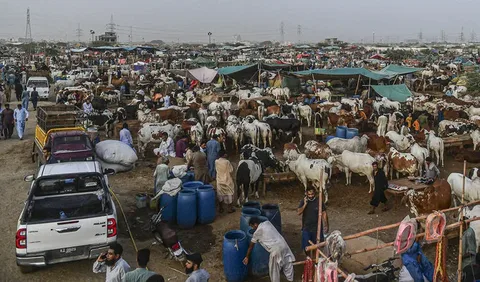
As Eid ul Adha 2026 draws near, sacrificial animal prices in Pakistan have reached record highs across major cities, leaving millions of ordinary citizens struggling to fulfill their religious obligation of Qurbani. Markets in Lahore, Islamabad, and Karachi are witnessing an unprecedented surge in livestock costs driven by inflation, higher fodder expenses, and rising fuel prices. From a standard goat to premium bulls, every category of sacrificial animal has become significantly more expensive compared to last year.
Background: Why Are Sacrificial Animal Prices Rising in 2026?
Every year ahead of Eid ul Adha, Pakistan experiences a massive surge in demand for livestock. Cattle markets spring up in every major city, drawing traders from rural areas and provincial regions who transport animals across hundreds of kilometers. This year, however, the combination of persistent inflation, costly animal feed, expensive fuel for transportation, and rising labor charges has pushed sacrificial animal prices in Pakistan to levels many families cannot afford.
Economic experts note that Pakistan slaughters approximately 7.4 million animals over the three days of Eid ul Adha, creating one of the country’s largest annual economic events. The scale of this market worth hundreds of billions of rupees means that even small shifts in input costs are felt immediately by the end buyer at the cattle market.
Sacrificial Animal Prices in Pakistan: Lahore 2026
Lahore remains one of the most active livestock markets in the country, with eight official cattle sale points operating across the city under the Punjab Cattle Market Management and Development Company (PCMMDC). Sites at Saggian, Wagah Sports Complex, Burki Road, LDA City, and Raiwind are all seeing heavy daily footfall but buyers are leaving disappointed.
Current Lahore Rates:
- Small goats: Rs. 90,000 – Rs. 120,000
- Medium goats and sheep: Rs. 150,000
- Premium and large goats/sheep: Rs. 180,000 – Rs. 500,000
- Ordinary bulls: Rs. 240,000 – Rs. 250,000
- Medium-quality bulls: Rs. 280,000 – Rs. 300,000
- Good-quality bulls: Rs. 300,000 – Rs. 400,000
- Premium bulls (show-quality): Rs. 800,000 – Rs. 1,400,000
These sacrificial animal prices in Pakistan’s Lahore markets reflect a sharp jump compared to last year, when small goats were available in the Rs. 40,000–55,000 range. Traders from Muzaffargarh and other districts say buyers are surprised by the rates and most commercial activity is expected to intensify in the final days before Eid when salary payouts are received.
Veterinary authorities have also issued a red alert for Congo virus at Lahore’s cattle markets and deployed medical staff to inspect animals for ticks. Citizens have been advised to examine all animals carefully before purchase.
Sacrificial Animal Prices in Pakistan: Islamabad & Rawalpindi 2026
In the twin cities of Rawalpindi and Islamabad, three major sacrificial animal markets Bhata Ground (Cantonment), I-12, and Rawat-Kallar Syedan are fully operational. Despite high stock levels, buyers remain few due to the unaffordable rates on offer.
Current Islamabad/Rawalpindi Rates:
- Goats (20 kg): Rs. 100,000 or more depending on breed
- Low-weight goats: Rs. 100,000 – Rs. 140,000
- Pair of goats: Rs. 300,000 – Rs. 380,000
- Buffaloes/cows (~100 kg, previously Rs. 150,000): Now Rs. 300,000
- Bulls (~200 kg): Rs. 300,000 – Rs. 400,000
- Collective (joint) Qurbani share: Rs. 70,000 – Rs. 80,000
One buyer, Abdul Manan, noted that a 35-kg goat he purchased last year for Rs. 50,000 is now being sold for Rs. 80,000 a 60 percent increase in a single year. Another citizen, Sardar Bashir, described prices as “excessively high,” noting buffaloes previously available for Rs. 150,000 have doubled in cost.
Contracts for the main Islamabad-area markets were auctioned at very high rates Bhata Ground at Rs. 165.7 million and I-12 at Rs. 55 million costs that are inevitably passed on to buyers through higher animal prices.
Sacrificial Animal Prices in Pakistan: Karachi 2026
In Karachi, sacrificial animal prices in Pakistan are comparatively slightly lower than Lahore, though the difference is marginal approximately Rs. 3,000–4,000 per animal. Authorities in Karachi have permitted the establishment of additional cattle markets to ease the expected rush and reduce overcrowding.
Current Karachi Rates:
- Standard goat (25 kg meat yield): Rs. 60,000 – Rs. 70,000 (up from Rs. 50,000–60,000 last year)
- Large and high-breed goats: Rs. 160,000 (up from Rs. 150,000 last year)
- Good-quality cow (~3 maunds): Rs. 200,000
- Bull share (one of seven parts): Rs. 28,000 – Rs. 32,000
- Premium animals at specialized farms: Rs. 500,000 and above
- Special breeds at select Karachi farms: Exceeding Rs. 10 million
Karachi markets are drawing traders from across Sindh’s interior and Balochistan, with animals arriving in the pre-dawn hours after days of travel. The closure of livestock export borders has increased local supply, yet prices have barely eased due to the heavy cost burden on traders.
The Economics: What Is Driving the Price Surge?
Multiple factors have converged to push sacrificial animal prices in Pakistan to their highest levels in recent memory:
Rising Feed Costs: The price of animal fodder has increased significantly over the past three years, directly adding to the cost of raising livestock.
Fuel and Transportation: Higher fuel costs make transporting animals from rural breeding areas to urban markets far more expensive than before, and these costs are transferred to buyers.
Inflation: Broad economic inflation across Pakistan has driven up everything from labor to veterinary medicines.
Market Auction Costs: Local governments auction market contracts at high prices, creating fixed cost burdens that traders pass through to consumers.
Heat and Health Risks: With Eid falling during Pakistan’s summer, extreme heat increases animal mortality risk during transport, adding pressure on traders to price in losses.
Traders defend the increases, saying their own operational costs have risen sharply. Citizens, meanwhile, are turning to collective Qurbani arrangements through mosques and welfare organizations to share costs among seven households as Islamic tradition permits for large animals such as cows, buffaloes, and camels.
Expert Perspective
Economic analysts who have studied the Eid livestock market describe it as one of Pakistan’s most significant annual economic moments larger than half the federal development budget in terms of cash flows over three days, with hundreds of billions of rupees circulating through an informal economy that includes livestock traders, transporters, butchers, tannery workers, and rural farmers.
Despite its enormous scale, this market operates with little formal data collection or government price regulation, leaving consumers fully exposed to market-driven price movements. Families who stretche their budgets to afford a sacrificial animal are now also facing sharply higher butcher fees: slaughtering a cow on the first day of Eid now costs Rs. 25,000–30,000 in Lahore, while a goat costs Rs. 10,000–15,000 near double last year’s rates in many cases.
Also In Pakistan Tech News: Kaiyi E Qute 04 Price in Pakistan Revealed
In a separate development drawing wide attention this week, Chinese automaker Kaiyi has officially entered the Pakistani automobile market through Q-Autos, a subsidiary of the Q-Links real estate group. The company launched three electric vehicles at a grand event in Lahore.
The most talked-about launch is the Kaiyi E Qute 04, an electric hatchback positioned between the size of a Suzuki Cultus and Suzuki Swift making it uniquely placed as a city commuter EV.
E Qute 04 Price in Pakistan:
- 300 km range variant: Rs. 4,490,000 (regular) | Rs. 3,990,000 (introductory, first 200 units)
- 400 km range variant: Rs. 5,190,000 (regular) | Rs. 4,690,000 (introductory, first 200 units)
- Booking amount: Rs. 490,000 for both variants
The E Qute 04 price in Pakistan makes it the most affordable fast-charging EV currently available in the country. The vehicle features a 360-degree camera a first in its category and comes with a 28.08 kWh battery in the base variant and a 39.26 kWh battery in the top variant.
Q-Autos also announced plans to establish a local CKD (completely knocked down) assembly plant in Pakistan to reduce costs further and support local production in the future.
Impact on Pakistani Families
The dual burden of record sacrificial animal prices in Pakistan and rising Eid expenses is putting significant financial pressure on middle- and lower-income households. Many families who saved through the year for Qurbani are finding that inflation has eroded their purchasing power well below what is needed this year.
Across Lahore, Islamabad, and Karachi cattle markets, a common scene is emerging: buyers arrive, inquire about prices, take photographs with animals, and leave empty-handed. In multiple markets, the ratio of visitors to actual purchasers has fallen sharply, as citizens look for cheaper options or pivot to collective sacrifice arrangements.
Conclusion: What to Expect Before Eid
With Eid ul Adha 2026 imminent, prices of sacrificial animals in Pakistan are unlikely to fall significantly. Traders note that some year-end price softening may occur in the final 24–48 hours before Eid as sellers attempt to avoid transporting unsold animals back. Buyers are advised to visit markets in the evening hours to take advantage of marginally better bargaining conditions and to inspect animals carefully for health issues including tick-borne illnesses.
The government is yet to announce any formal price control mechanism for livestock. District administrations in Karachi, Lahore, and other cities have focused on market management and veterinary oversight rather than pricing intervention.
FAQs
Which animal farming is best in Pakistan?
Goat farming is widely considered the most profitable and accessible form of livestock farming in Pakistan. Goats are low-maintenance, require less feed compared to cattle, reproduce quickly, and have strong year-round demand particularly ahead of Eid ul Adha. Poultry farming is also highly profitable at a commercial scale. For larger operations, dairy cattle farming offers consistent income through milk production, while beef cattle farming generates significant returns around Eid ul Adha each year.
What are 12 cows called?
A group of cows does not have a widely standardized term specifically for 12, but a group of cattle in general is called a “herd.” In some contexts, a smaller group of cattle may be called a “drove.” The number 12 itself does not carry a special collective noun in livestock terminology.
How many shares are in 1 cow Qurbani?
In Islamic tradition, one cow, buffalo, or camel is sufficient for the Qurbani of seven people. This means a single large animal can be divided into seven equal shares (hissas), each counting as a full Qurbani for one person or one household. For small animals such as goats and sheep, each animal counts as the Qurbani for only one person and cannot be shared.