Scientists have identified a previously unknown Zimbabwe dinosaur species dating back roughly 210 million years, offering fresh evidence that southern Africa hosted a far more diverse range of prehistoric ecosystems than researchers had previously understood. The discovery, named Musango matusadonaensis, marks only the fifth dinosaur species ever formally documented in the country.
Background
The fossil at the heart of this Zimbabwe dinosaur discovery was excavated back in 2018 along the shores of Lake Kariba in northern Zimbabwe, one of the largest artificial lakes in the world. It took an international team of researchers from Zimbabwe, South Africa, and the United Kingdom several years to fully analyze and formally describe the specimen.
Their findings were published this week in the Journal of Systematic Palaeontology, adding Musango to a short but growing list of dinosaurs known from Zimbabwe. Until now, only four other dinosaur species had been named from the country, making its paleontological record relatively sparse compared to better-studied regions of southern Africa.
This new discovery builds on Zimbabwe’s recent paleontological momentum. In 2022, researchers in the country identified Mbiresaurus raathi, considered Africa’s oldest known dinosaur at roughly 230 million years old, a smaller creature standing about a meter tall. Musango, found six years later but only now formally described, represents a somewhat later chapter of the same prehistoric period.
Details
Musango matusadonaensis lived during the Late Triassic period, a time when dinosaurs were only beginning to spread across the planet and had not yet become the dominant land animals on Earth. The name Musango comes from the Shona word meaning “living in the bush,” reflecting both the local language and the wooded habitat where the fossil was uncovered.
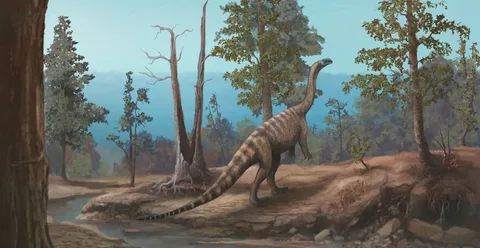
Unlike the massive long-necked sauropods that would evolve millions of years later, Musango was a relatively lightly built animal, measuring around 4.5 meters in length and weighing an estimated 222 kilograms. Researchers believe it was likely a herbivore or omnivore, feeding on plants growing along ancient rivers and streams, though its skull has not yet been recovered.
The specimen is considered one of the most complete dinosaur skeletons of its age ever found in Zimbabwe, with well-preserved bones from the spine, ribs, arms, legs, and feet. Scientists estimated the individual was about eight years old and nearly fully grown at the time of its death, and its bones showed signs of a serious injury or infection that it had survived before eventually dying.
What makes this Zimbabwe dinosaur significant beyond its physical characteristics is what it suggests about the broader region during the Late Triassic. Previously, scientists had assumed dinosaurs living across southern Africa during this period were largely similar across the region. Musango’s distinct anatomy challenges that assumption, pointing instead to multiple separate ecosystems, each supporting its own specialized dinosaur species.
Quotes
Paul Barrett, a researcher at the Natural History Museum in London who worked on the study, said the discovery suggests different dinosaur species occupied distinct ecosystems across southern Africa, pointing to far greater diversity than previously recognized.
Barrett added that the findings likely represent just a small fraction of what remains to be discovered in the region, describing the current fossil record as only the tip of the iceberg when it comes to understanding prehistoric Zimbabwe.
Researchers involved in the excavation noted that the fossil’s location, on the shores of Lake Kariba and partly accessible only by boat, made the recovery process especially challenging. That difficulty says something about how much of Zimbabwe’s fossil record likely remains unexplored in similarly remote areas.
Impact
This Zimbabwe dinosaur discovery carries significant weight for paleontologists studying how dinosaurs first spread and diversified across the ancient supercontinent of Pangaea. Evidence of distinct regional ecosystems within southern Africa, rather than one uniform prehistoric landscape, could reshape broader theories about early dinosaur evolution and migration patterns.
The find also strengthens Zimbabwe’s growing reputation as an important, if still underexplored, site for paleontological research. With only five dinosaur species formally identified in the country so far, researchers say there is considerable potential for future discoveries, particularly in remote areas like the Lake Kariba basin that have not yet been extensively surveyed.
Beyond the scientific community, the discovery adds to a wave of positive international attention for Zimbabwe’s natural heritage, offering a rare counterpoint to the country’s more frequent appearances in international headlines tied to its political and economic challenges.
Conclusion
Researchers say the description of Musango matusadonaensis is unlikely to be the last major dinosaur find from Zimbabwe, given how much of the country’s fossil-bearing rock formations remain unstudied. With international collaboration continuing between Zimbabwean, South African, and British paleontologists, scientists expect further excavations around Lake Kariba and other Triassic-era sites to yield additional species in the coming years.
For now, Musango stands as a reminder that even well-trodden regions of the fossil record can still hold significant surprises, more than two centuries after dinosaurs first began capturing scientific and public imagination.
Frequently Asked Questions
What’s happening in Zimbabwe right now?
Beyond the recent dinosaur discovery drawing international scientific attention, Zimbabwe has also been navigating a significant domestic political moment, with President Emmerson Mnangagwa’s government implementing a constitutional amendment that extends presidential terms and pushes back the next general election. On the economic front, the country continues to work through longstanding challenges including currency instability and the effects of ongoing US sanctions on senior officials. The Musango dinosaur find offers a notable moment of positive global attention for Zimbabwe’s scientific and natural heritage amid these broader political and economic storylines.
Why was the Zimbabwe match abandoned?
This question typically refers to cricket rather than paleontology, and Zimbabwe’s national team has had several matches called off in 2026 due to weather conditions, most notably during the ICC Men’s T20 World Cup, when their group match against Ireland in Pallekele was abandoned without a toss because of persistent rain. That particular abandonment ultimately worked in Zimbabwe’s favor, since the shared points were enough to see them advance while eliminating both Australia and Ireland from that stage of the tournament. Additional matches during Zimbabwe’s domestic T20 competition and its A-team tour of Bangladesh were also abandoned earlier in the year for similar weather-related reasons.
What is Donald Trump saying about Zimbabwe?
The Trump administration has continued renewing sanctions against senior Zimbabwean officials, including President Mnangagwa and his wife, citing ongoing concerns about corruption and human rights under the Global Magnitsky Act. Earlier this year, Trump also imposed an 18 percent tariff on Zimbabwean exports as part of a broader global trade policy shift, a move that prompted Mnangagwa to suspend Zimbabwe’s own tariffs on US goods in an apparent effort to improve relations with Washington. These political and economic developments remain separate from, and unconnected to, Zimbabwe’s recent paleontological achievements, which have been welcomed across the political spectrum as a point of national scientific pride.