

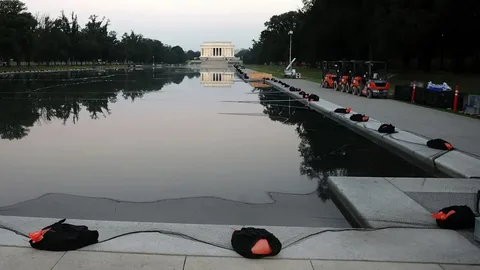
The Justice Department has moved to dismiss the felony case against former Olympic canoeist David Hearn, admitting that damage to the Lincoln Memorial Reflecting Pool was caused by a flawed contractor installation rather than deliberate vandalism. The reversal comes just three weeks before Hearn’s trial was scheduled to begin in Washington.
Background
The Lincoln Memorial Reflecting Pool underwent a $14 million renovation as part of a broader beautification push ordered by President Donald Trump ahead of the America 250 celebrations marking the country’s 250th anniversary. The project, carried out by contractor Atlantic Industrial Coatings, involved installing a new blue liner across the bottom of the pool.
On June 19, Hearn, a three-time Olympic canoeist from Bethesda, Maryland, stopped at the pool during a 50-mile bike ride and noticed sections of the newly installed liner had come loose. He reached in to examine the peeling material, prompting his detention by National Guard troops and U.S. Park Police for roughly five hours.
Hearn was indicted on July 2 on one felony count of destruction of government property, a charge carrying a maximum sentence of 10 years and accusing him of causing more than $1,000 in damage. He pleaded not guilty on July 9, with a trial originally scheduled to start September 28 in D.C. Superior Court.
Details
In a 20-page court filing submitted Friday, D.C. U.S. Attorney Jeanine Pirro’s office said newly obtained documents from the Interior Department showed the pool’s problems began well before Hearn’s visit. A National Park Service engineer had flagged peeling in the liner around the pool’s perimeter on June 11, more than a week before Hearn was accused of vandalizing that same section.
Prosecutors said installation work on the pool liner fell behind schedule due to a mix of rainy, windy weather, repeated failures in testing the sealing of expansion joints, and delays in obtaining sealing materials, all compounded by pressure to finish the project before the July Fourth America 250 events. The filing placed responsibility on both Atlantic Industrial Coatings and the Interior Department, which prosecutors said had provided “less than fulsome information” when the case was first brought.
The reflecting pool news reached a turning point when prosecutors concluded it was “difficult to attribute the widespread damage to the Reflecting Pool to vandalism, let alone to establish that fact beyond a reasonable doubt.” The motion effectively reverses the government’s original account, which had accused Hearn of forcefully ripping up the liner with his bare hands.
The final decision on whether to formally dismiss the case now rests with the judge overseeing it. Atlantic Industrial Coatings had previously acknowledged in a public statement that some areas of the reflecting pool required repairs, though the company did not immediately comment on the DOJ’s conclusions.
Quotes
Hearn’s attorneys, Norm Eisen, Mary Dohrmann, and Steve Levin, said in a statement that the case against their client should never have been brought, describing the government’s approach as “ready, fire, aim” and stating that the dismissal does not erase what they called an abuse of government power.
U.S. Attorney Jeanine Pirro’s office, in the filing dropping the charge, wrote that the newly discovered information significantly undermined the evidentiary basis for the original indictment supplied by the Department of the Interior and U.S. Park Police.
The U.S. attorney’s office declined to comment further on the dismissal when contacted by reporters, and it remains unclear when the presiding judge will formally rule on the motion to drop the case.
Impact
The reversal raises fresh questions about the oversight of high-profile federal construction projects tied to the America 250 celebrations, particularly given prosecutors’ admission that the Interior Department withheld relevant information early in the case. It also highlights the risks of rushing headline infrastructure projects ahead of politically significant deadlines.
For Hearn personally, the dismissal ends a monthslong legal ordeal that drew public attention and supporter rallies outside the courthouse, though his legal team has suggested the episode caused lasting reputational and personal harm that a dismissal alone cannot fully address.
The case also puts renewed scrutiny on Atlantic Industrial Coatings, the contractor that received a multimillion-dollar deal to complete the reflecting pool renovation, and raises questions about whether the company or federal agencies involved will face any further accountability for the botched installation.
Conclusion
With the motion to dismiss now before the court, attention turns to whether the judge will grant the request in the coming weeks and whether any further findings emerge about the Interior Department’s handling of information during the original investigation. The reflecting pool renovation itself remains unfinished business for the administration, which had promoted the project as a signature piece of its broader beautification push for the capital.
For now, the case stands as a cautionary example of how fast an initial vandalism narrative can unravel once contractor and agency records come under closer examination.
Frequently Asked Questions
What charge was David Hearn facing?
David Hearn, a three-time Olympic canoeist, was indicted on one felony count of destruction of government property after authorities alleged he deliberately damaged the newly installed liner of the Lincoln Memorial Reflecting Pool during a visit on June 19, 2026. The charge carried a maximum possible sentence of 10 years in prison and accused him of causing more than $1,000 in damage to the pool’s lining. Hearn pleaded not guilty to the charge on July 9, and his case had been scheduled for trial in D.C. Superior Court before prosecutors moved to dismiss it entirely.
Why did the DOJ drop the Reflecting Pool case?
Prosecutors dropped the case after newly obtained documents from the Interior Department revealed that damage to the pool’s liner had begun before Hearn’s visit and was linked to a rushed, flawed installation process rather than deliberate vandalism. Engineers had already flagged peeling in the same section of the liner over a week before Hearn was accused of causing the damage, and prosecutors concluded that weather delays, testing failures, and pressure to finish the project before America 250 events had compromised the contractor’s work. Given this new evidence, the U.S. Attorney’s office said it could no longer credibly argue the damage was caused by criminal vandalism beyond a reasonable doubt.
Who is responsible for the Reflecting Pool damage?
Based on the Justice Department’s own filing, primary responsibility appears to rest with Atlantic Industrial Coatings, the contractor hired to install the new pool liner, whose work reportedly fell behind schedule due to weather issues, repeated sealing test failures, and rushed timelines tied to Independence Day and America 250 celebrations. The Interior Department also faced criticism in the filing for providing what prosecutors called “less than fulsome information” during the early stages of the investigation into David Hearn. No individual has been formally held accountable for the installation failures at this stage, and it remains to be seen whether further scrutiny of the contractor or federal agencies involved will follow the dismissal of charges against Hearn.