
US President Donald Trump claims Morocco has named a new $1 billion highway through Western Sahara after him, a gesture that, if confirmed, would underscore just how far Washington’s 2020 recognition of Moroccan sovereignty over the disputed territory has reshaped regional politics. Morocco’s government has so far stayed silent on the announcement.
Background
Understanding why the highway naming matters requires understanding Western Sahara itself. The territory sits on Africa’s northwest Atlantic coast, bordering Morocco, Algeria, and Mauritania, and has been at the center of one of the world’s longest-running territorial disputes since Spain withdrew as its colonial ruler in 1975.
Morocco currently administers roughly 80 percent of Western Sahara, including its largest cities, while the Polisario Front, representing the region’s indigenous Sahrawi people, controls a thin strip of territory along the Algerian border and continues to push for full independence. The dispute over whether Western Sahara is a country in its own right remains unresolved at the United Nations, which classifies it as a non-self-governing territory awaiting decolonization.
Why does Morocco want Western Sahara? Rabat considers the region part of its historical “southern provinces” and has invested heavily in integrating it economically, citing the area’s rich phosphate deposits, fishing waters, and potential as an Atlantic trade gateway connecting Europe and Africa with landlocked Sahel nations like Mali, Burkina Faso, and Niger.
Details
The current story centers on the Tiznit-Dakhla highway, a 1,055-kilometer road that became fully operational in January after roughly a decade of construction. The route runs along the Morocco Western Sahara border region and beyond, connecting Tiznit through Guelmim and Tan-Tan, passing through Laayoune, the largest city in Moroccan-administered Western Sahara, before reaching the Dakhla Peninsula in the south.
On Truth Social, Trump posted a video showing sweeping desert landscapes along the route and thanked Morocco’s King Mohammed VI, saying he looked forward to traveling the “Great Highway” himself one day. The clip described the road as one of Africa’s longest, stretching across roughly 7 percent of the continent’s Atlantic coastline.
However, fact-checkers at Snopes noted that Morocco’s government had not independently confirmed the naming as of this week, and that Trump’s announcement video appeared to feature an AI-generated narration based on its audio characteristics. Multiple outlets, including Forbes, Bloomberg, and Morocco’s own Hespress, reported on the claim without independent confirmation from Rabat itself.
Regardless of whether the formal naming is confirmed, the highway itself is real and significant. It forms part of Morocco’s broader “Atlantic Initiative,” launched in 2023, aimed at using its position between the Mediterranean and Atlantic to become a regional trade hub. According to the Konrad Adenauer Stiftung think tank, African exports routed through Morocco grew from $300 million in 2004 to $3 billion in 2024.
Quotes
Trump wrote directly to Morocco’s monarch in his social media post, thanking “Highly Respected Mohammed VI, the King of Morocco” for what he called “such a great honor,” adding that he hoped to travel the highway’s full length himself someday soon.
Commentator Said Temsamani, writing in The Arab Weekly, described the Tiznit-Dakhla road as more than physical infrastructure, arguing it reflects the emergence of a new Moroccan geography built around ambition, partnership, and global engagement rather than simple road-building.
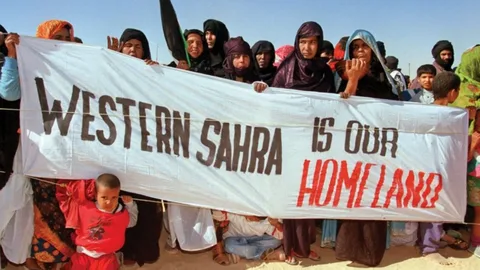
Rights advocates and Polisario Front supporters have long rejected Morocco’s framing of the territory, with independence campaigners continuing to describe Western Sahara as Africa’s last colony and pointing to reports of repression faced by Sahrawi activists living under Moroccan administration.
Impact
The episode carries real diplomatic weight beyond the highway itself. The United States formally recognized Moroccan sovereignty over Western Sahara in December 2020, a move made in exchange for Morocco normalizing relations with Israel under the Trump-brokered Abraham Accords. That recognition remains one of the most significant diplomatic wins Morocco has secured in its decades-long push for international acceptance of its claim.
Still, most of the world does not recognize Morocco’s sovereignty over the territory, and the question of whether Western Sahara is part of Morocco or an independent state remains a matter of active dispute at the UN and among African Union members. Algeria continues to back the Polisario Front and host hundreds of thousands of Sahrawi refugees in camps across its southwestern border.
For ordinary residents, the Morocco Western Sahara border areas and southern cities have seen a genuine infrastructure boom, with new ports, roads, and foreign investment flowing into Laayoune and Dakhla. Critics argue this development serves to cement Moroccan control before any future resolution, while supporters frame it as long overdue economic progress for the region.
Conclusion
Whether or not Morocco formally confirms the highway’s new name, the episode has put renewed global attention on Western Sahara’s unresolved status and Washington’s outsized role in shaping how the dispute is perceived internationally. Morocco keeps expanding infrastructure across the territory and pushing its Atlantic Initiative forward, and the coming months will likely bring further diplomatic moves testing how far the rest of the world is willing to follow the US position on the region’s sovereignty.
Frequently Asked Questions
Why did Morocco invade Western Sahara?
Morocco’s move into Western Sahara followed Spain’s withdrawal as the territory’s colonial ruler in 1975. Morocco organized the “Green March,” sending hundreds of thousands of civilians into the territory to press its historical claim, while also deploying military forces alongside Mauritania, which briefly claimed a southern portion of the territory before withdrawing in 1979. Morocco has consistently argued the region was historically part of its kingdom prior to Spanish colonization, a claim that Sahrawi independence advocates and the Polisario Front dispute, arguing instead for the right to self-determination promised under UN decolonization principles.
Why is Morocco split in two?
Morocco itself is not formally split in two, but the broader territory it administers, including Western Sahara, is separated by a lengthy sand-and-stone barrier known as the Moroccan Wall or “berm.” This roughly 2,700-kilometer structure, built in stages during the 1980s, separates Moroccan-controlled Western Sahara to the west from the narrower strip of territory controlled by the Polisario Front to the east, which borders Algeria. The wall remains heavily militarized and mined, and it effectively functions as a de facto boundary between the two sides even though no permanent international border has been formally recognized there.
What is the current situation in Western Sahara?
The situation in Western Sahara remains a frozen but occasionally tense conflict. A UN-monitored ceasefire between Morocco and the Polisario Front, in place since 1991, broke down partially in November 2020 after clashes near the Guerguerat border crossing, though large-scale fighting has not resumed since. Morocco continues to control the majority of the territory and has invested heavily in its economic development, while Polisario-aligned forces occasionally report sporadic skirmishes along the berm. Diplomatically, the UN Security Council continues to renew the mandate of its peacekeeping mission, MINURSO, though a long-promised referendum on self-determination for the Sahrawi people has never been held, leaving the region’s final political status unresolved after nearly five decades.